Ptolemos – Claudius Ptolemy the Mathematician
https://www.wizard101central.com/wiki/Creature:Ptolemos
https://www.wizard101central.com/wiki/Quest:Trial_of_the_Spheres
https://en.wikipedia.org/wiki/Ptolemy
https://en.wikipedia.org/wiki/Ptolemy%27s_theorem

Ptolemos is the next to last Boss in the trial of Spheres in Celestia.
You are not as charming as you imagine yourself. Consider that.
Ptolemos
Claudius Ptolemy (Latin: Claudius Ptolemaeus; c. 100 – c. 170 AD) was a mathematician, astronomer, astrologer, geographer, and music theorist, who wrote about a dozen scientific treatises, three of which were of importance to later Byzantine, Islamic, and Western European science. The first is the astronomical treatise now known as the Almagest, although it was originally entitled the Mathēmatikē Syntaxis or Mathematical Treatise, and later known as The Greatest Treatise. The second is the Geography, which is a thorough discussion on maps and the geographic knowledge of the Greco-Roman world. The third is the astrological treatise in which he attempted to adapt horoscopic astrology to the Aristotelian natural philosophy of his day. This is sometimes known as the Apotelesmatika (lit. “On the Effects”) but more commonly known as the Tetrábiblos, from the Koine Greek meaning “Four Books”, or by its Latin equivalent Quadripartite.
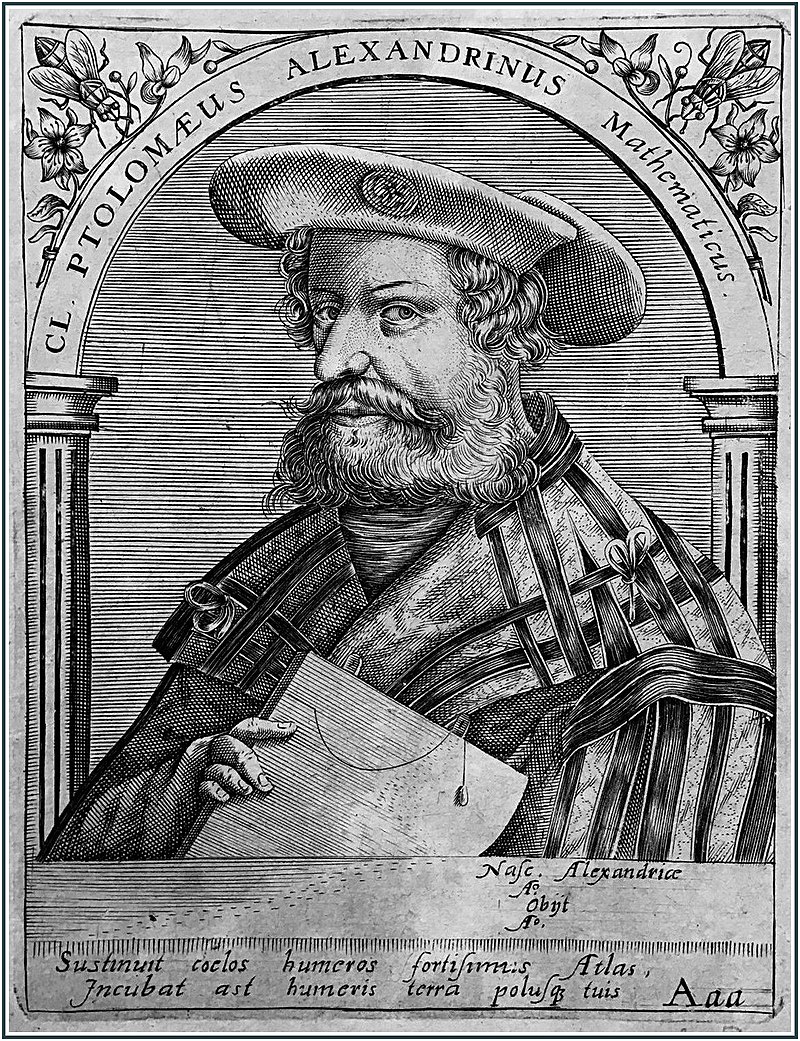
Unlike most ancient Greek mathematicians, Ptolemy’s writings (foremost the Almagest) never ceased to be copied or commented upon, both in Late Antiquity and in the Middle Ages. However, it is likely that only a few truly mastered the mathematics necessary to understand his works, as evidenced particularly by the many abridged and watered-down introductions to Ptolemy’s astronomy that were popular among the Arabs and Byzantines alike.
Though accurate for predicting the positions of the sun, moon and stars, Ptolemy’s astronomical model is geocentric (Earth centered) and not heliocentric (Sun centered). As such Ptolemy is chiefly remember for his math theorem:
(warning Math to follow)
In Euclidean geometry, Ptolemy’s theorem is a relation between the four sides and two diagonals of a cyclic quadrilateral (a quadrilateral whose vertices lie on a common circle). The theorem is named after the Greek astronomer and mathematician Ptolemy (Claudius Ptolemaeus). Ptolemy used the theorem as an aid to creating his table of chords, a trigonometric table that he applied to astronomy.
If the vertices of the cyclic quadrilateral are A, B, C, and D in order, then the theorem states that:
| A C ¯ | ⋅ | B D ¯ | = | A B ¯ | ⋅ | C D ¯ | + | B C ¯ | ⋅ | A D ¯ |
where the vertical lines denote the lengths of the line segments between the named vertices. This relation may be verbally expressed as follows:
If a quadrilateral is inscribable in a circle then the product of the lengths of its diagonals is equal to the sum of the products of the lengths of the pairs of opposite sides.

Moreover, the converse of Ptolemy’s theorem is also true:
In a quadrilateral, if the sum of the products of the lengths of its two pairs of opposite sides is equal to the product of the lengths of its diagonals, then the quadrilateral can be inscribed in a circle i.e. it is a cyclic quadrilateral.
The current list of all the (known) Celestia references are located here.
Although I am well versed in Pop Culture references, I do not claim to have caught them all. Let me know your favorites in the comments and if I’ve missed one you caught, let me know so I can add it to the list.
Text for this article is excerpted from the linked wiki pages
Potolemos image is from Wizard101, and is copyright of KingsIsle Entertainment.
Ptolemy engraving is borrowed from Wikipedia it is in the public domain.
The visual guide to Ptolemy’s Theorum is borrowed from wikipedia and is shared under the Creative Commons license CC BY 3.0
Image usage qualifies as fair use under US copyright law.
 Vulcan Stev's Database