
Sir Malory – Mordred / Sir Thomas Malory
https://www.wizard101central.com/wiki/Creature:Sir_Malory
https://en.wikipedia.org/wiki/Mordred
https://en.wikipedia.org/wiki/Thomas_Malory
https://en.wikipedia.org/wiki/Le_Morte_d%27Arthur
When you first encounter the spirit of Sir Malory he is known as the Nameless Knight. After finding the Sword of Kings he is revealed to be Sir Malory.
Sir Malory was Morganthe’s brother and a knight of Avalon. He ultimately betrayed King Artorius in order to wield the Sword of Kings and become king for himself and ended up taking his own life in the process. Artorius survived Malory’s inflictions, but not before becoming the dreaded Pendragon.
Sir Malory takes his actions and motivations from Mordred of Arthurian legend. His name is inspired by the compiler/author of the primary English work about Arthur’s reign, Sir Thomas Malory.
Mordred or Modred is a figure who is variously portrayed in the legend of King Arthur. The earliest known mention of a possibly historical Medraut is in the Welsh chronicle Annales Cambriae, wherein he and Arthur are ambiguously associated with the Battle of Camlann in a brief entry for the year 537. Medraut’s figure seemed to have been regarded positively in the early Welsh tradition and may have been related to that of Arthur’s son.

from The Book of Romance, edited by Andrew Lang.
New York: Longmans, Green and Co., 1902.
As Modredus, Mordred was depicted as Arthur’s traitorous nephew and a legitimate son of King Lot in Geoffrey of Monmouth’s pseudo-historical work Historia Regum Britanniae which then served as the basis for the following evolution of the legend from the 12th century. Later variants most often characterized him as Arthur’s villainous bastard son, born of an incestuous relationship with his half-sister, the queen of Lothian or Orkney named either Anna, Orcades, or Morgause. The accounts presented in the Historia and most other versions include Mordred’s death at Camlann, typically in a final duel, during which he manages to mortally wound his own slayer, Arthur.
Sir Thomas Malory was an English writer, the author of Le Morte d’Arthur, the classic English-language chronicle of the Arthurian legend, compiled and in most cases translated from French sources. The most popular version of Le Morte d’Arthur was published by the famed London printer William Caxton in 1485. Much of Malory’s life history is obscure, but he identified himself as a “knight prisoner”, apparently reflecting that he was either a criminal or a prisoner-of-war. Malory’s identity has never been confirmed. However, since modern scholars began researching his identity the most widely accepted candidate has been Sir Thomas Malory of Newbold Revel in Warwickshire, who was imprisoned at various times for criminal acts and possibly also for political reasons during the Wars of the Roses.
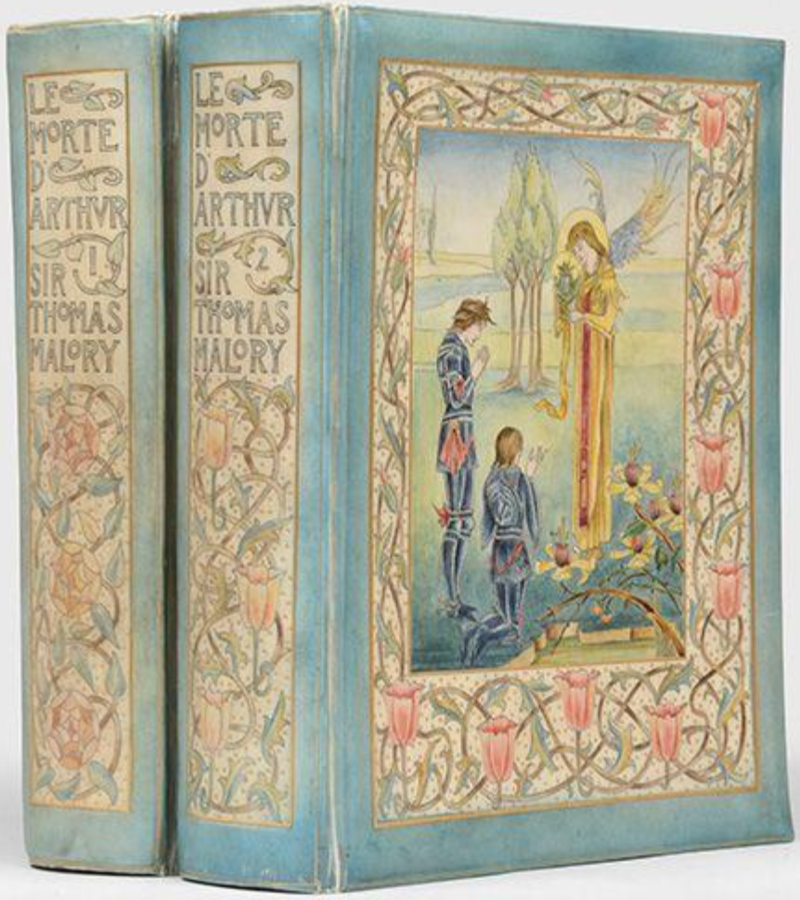
Le Morte d’Arthur (originally written as le morte Darthur; inaccurate Middle French for “The Death of Arthur”) is a 15th-century Middle English prose reworking by Sir Thomas Malory of tales about the legendary King Arthur, Guinevere, Lancelot, Merlin and the Knights of the Round Table, along with their respective folklore. In order to tell a “complete” story of Arthur from his conception to his death, Malory compiled, rearranged, interpreted and modified material from various French and English sources. Today, this is one of the best-known works of Arthurian literature. Many authors since the 19th-century revival of the legend have used Malory as their principal source.
Apparently written in prison at the end of the medieval English era, Le Morte d’Arthur was completed by Malory around 1470 and was first published in a printed edition in 1485 by William Caxton. Until the discovery of the Winchester Manuscript in 1934, the 1485 edition was considered the earliest known text of Le Morte d’Arthur and that closest to Malory’s original version. Modern editions under myriad titles are inevitably variable, changing spelling, grammar and pronouns for the convenience of readers of modern English, as well as often abridging or revising the material.
The current list of all the (known) Avalon references are located here.
Although I am well versed in Pop Culture references, I do not claim to have caught them all. Let me know your favorites in the comments and if I’ve missed one you caught, let me know so I can add it to the list.
Text for this article is excerpted from the linked wiki pages
Sir Malory image is from Wizard101, and is copyright of KingsIsle Entertainment.
Mordred image is borrowed from Wikipedia and is in the public domain.
Le Morte d’Arthur cover image is borrowed from Wikipedia and is in the public domain.
Image usage qualifies as fair use under US copyright law.
 Vulcan Stev's Database