The Jabberwock – Jabberwocky, The Jabberwock
https://www.wizard101central.com/wiki/Creature:Jabberwock
https://en.wikipedia.org/wiki/Lewis_Carroll
https://en.wikipedia.org/wiki/Alice%27s_Adventures_in_Wonderland
https://en.wikipedia.org/wiki/Jabberwocky
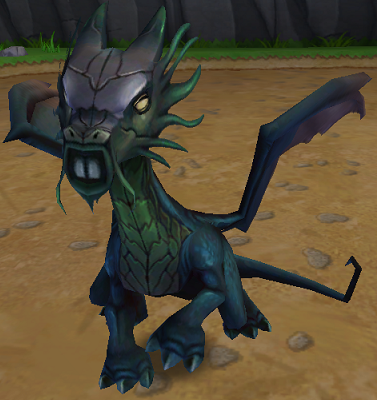
The Dark Knight sends you on the quest to retrieve the “Hearts of the Jabberwock”. The Quest is entitled ‘Twas Brillig’ and the one that immediately follows is entitled ‘O Frabjous Day’. You need to purify the “Hearts of the Jabberwock” at the Shrine to Loyalty in the Face of Gloom, Melancholy, Angst, Bitterness and Snark.
This slithy wyrm whiffles and burbles in its lair among the Tumtum trees. Your wizard gyres by the grove of the Tumtum tress to the Jabberwock’s lair.
Beware the Jabberwock! The jaws that bite! The claws that catch!
Jabberwock
“Callooh! Callay” – Jabberwock
Monstrology Tome Description
Unpure are the Hearts of the Jabberwock though they can be cleansed in the face of Gloom, Melancholy, Angst, Bitterness and Snark.
As you subdue the slithy beast, it hacks up a tulgey gob. The Hearts of the Jabberwock are contained in the mimsy mess. Upon completing the quest your Wizard is promoted to Knight Errant.
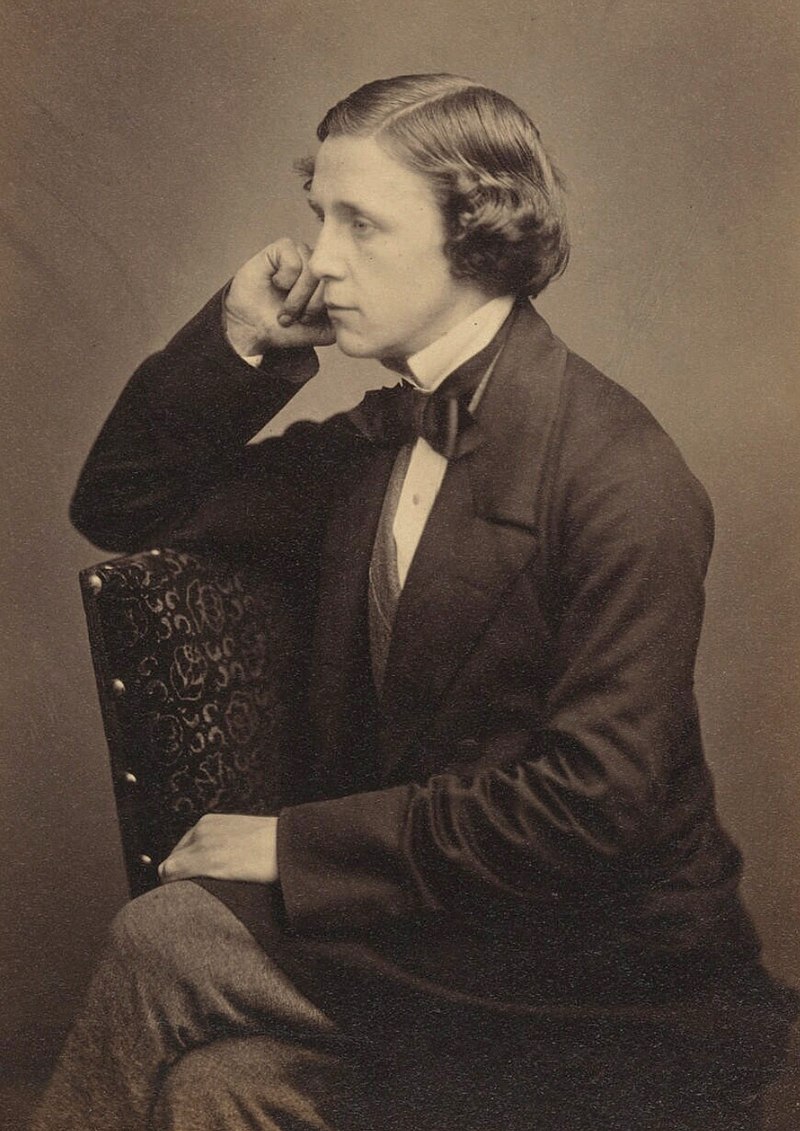
This creature and the quest surrounding it are a shout out to the works of Lewis Carrol.
Charles Lutwidge Dodgson (January 27, 1832 – January 14, 1898), better known by his pen name Lewis Carroll, was an English author, poet and mathematician. His most notable works are Alice’s Adventures in Wonderland (1865) and its sequel Through the Looking-Glass (1871). He was noted for his facility with word play, logic, and fantasy. His poems Jabberwocky (1871) and The Hunting of the Snark (1876) are classified in the genre of literary nonsense.
Alice’s Adventures in Wonderland (commonly Alice in Wonderland) is an 1865 English novel by Lewis Carroll, a mathematics professor at Oxford University. It details the story of a young girl named Alice who falls through a rabbit hole into a fantasy world of anthropomorphic creatures. It is seen as an example of the literary nonsense genre. The artist John Tenniel provided 42 wood-engraved illustrations for the book.
The book has never been out of print and has been translated into 174 languages. Its legacy covers adaptations for screen, radio, art, ballet, opera, musicals, theme parks, board games and video games. Carroll published a sequel in 1871 entitled Through the Looking-Glass and a shortened version for young children, The Nursery “Alice” in 1890.
“Jabberwocky” is a nonsense poem written by Lewis Carroll about the killing of a creature named “the Jabberwock”. It was included in his 1871 novel Through the Looking-Glass, the sequel to Alice’s Adventures in Wonderland (1865). The book tells of Alice’s adventures within the back-to-front world of Looking-glass world.
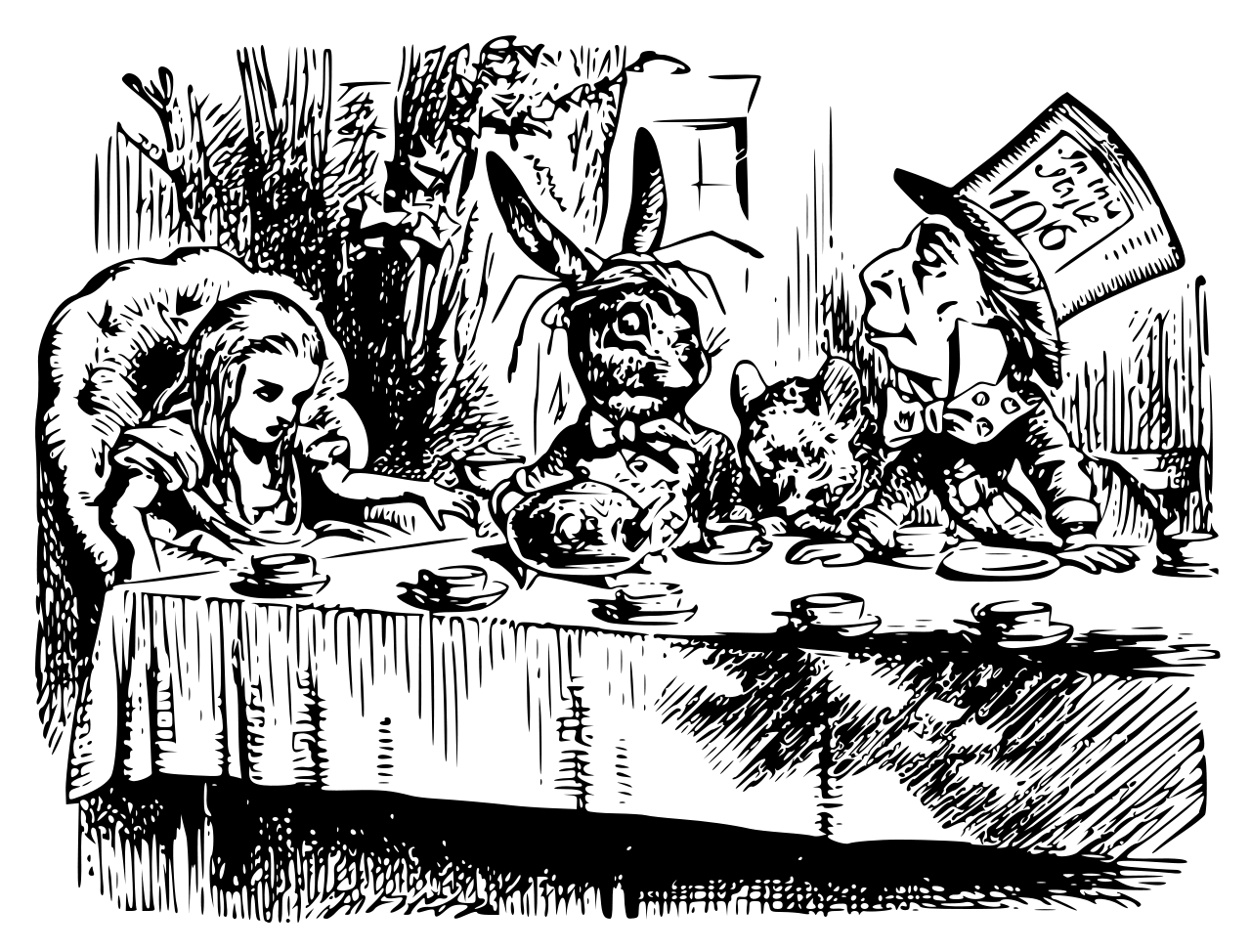
John Tenniel – artist
In an early scene in which she first encounters the chess piece characters White King and White Queen, Alice finds a book written in a seemingly unintelligible language. Realizing that she is traveling through an inverted world, she recognizes that the verses on the pages are written in mirror-writing. She holds a mirror to one of the poems and reads the reflected verse of “Jabberwocky”. She finds the nonsense verse as puzzling as the odd land she has passed into, later revealed as a dreamscape.
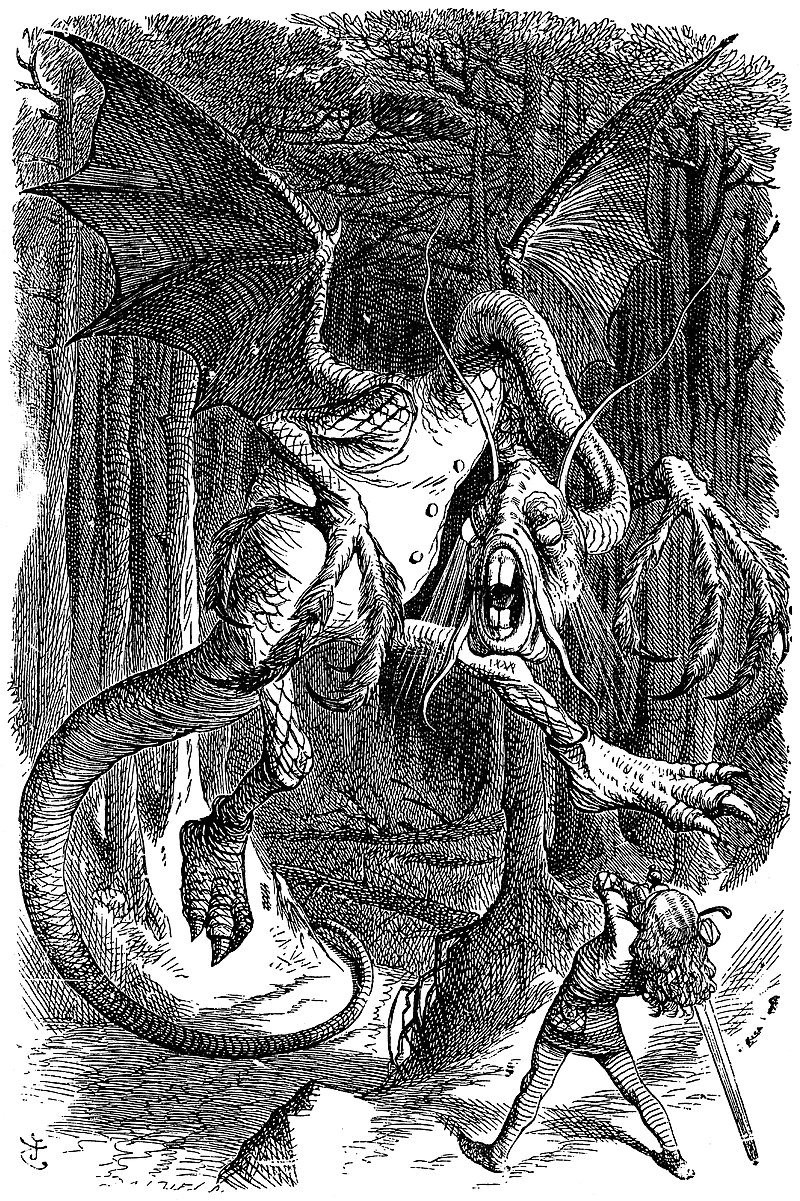
John Tenniel – artist
"Jabberwocky"

'Twas brillig, and the slithy toves
Did gyre and gimble in the wabe;
All mimsy were the borogoves,
And the mome raths outgrabe.

"Beware the Jabberwock, my son!
The jaws that bite, the claws that catch!
Beware the Jubjub bird, and shun
The frumious Bandersnatch!"

He took his vorpal sword in hand:
Long time the manxome foe he sought—
So rested he by the Tumtum tree,
And stood awhile in thought.

And as in uffish thought he stood,
The Jabberwock, with eyes of flame,
Came whiffling through the tulgey wood,
And burbled as it came!

One, two! One, two! And through and through
The vorpal blade went snicker-snack!
He left it dead, and with its head
He went galumphing back.

"And hast thou slain the Jabberwock?
Come to my arms, my beamish boy!
O frabjous day! Callooh! Callay!"
He chortled in his joy.

'Twas brillig, and the slithy toves
Did gyre and gimble in the wabe;
All mimsy were the borogoves,
And the mome raths outgrabe.

from Through the Looking-Glass, and
What Alice Found There (1871)
Scholars have debated the meaning of the nonsense words in this poem for decades. Some have even entered modern usage. The words used in the quest are defined thusly:
Brillig: Following the poem, the character of Humpty Dumpty comments: “‘Brillig’ means four o’clock in the afternoon, the time when you begin broiling things for dinner.”
Frabjous: Possibly a blend of “fair”, “fabulous”, and “joyous”.
Slithy: Humpty Dumpty says: “‘Slithy’ means ‘lithe and slimy’. ‘Lithe’ is the same as ‘active’. You see it’s like a portmanteau, there are two meanings packed up into one word.” The original in Mischmasch notes that ‘slithy’ means “smooth and active”. The i is long, as in writhe.
Burbled: In a letter of December 1877, Carroll notes that “burble” could be a mixture of the three verbs ‘bleat’, ‘murmur’, and ‘warble’.
The Tumtum Tree, is a fictional tree mentioned in the poem “Jabberwocky” by Lewis Carroll.
Gyre: “To ‘gyre’ is to go round and round like a gyroscope.” Gyre is entered in the Oxford English Dictionary from 1420, meaning a circular or spiral motion or form; especially a giant circular oceanic surface current. Carroll also wrote in Mischmasch that it meant to scratch like a dog. The g is pronounced like the /g/ in gold, not like gem
Callooh, Cally: Come on, let’s go! Callooh is from Chalo =चलो, Callay is Chale =चले. This has been taken from the Hindi phrase :चलो चले! Though in the poem they are exclamations of joy and are equivalent to ‘hurrah’ and ‘hooray’.
Tulgey: Carroll himself said he could give no source for this word. It could be taken to mean thick, dense, dark. It has been suggested that it comes from the Anglo-Cornish word tulgu, ‘darkness’, which in turn comes from Cornish tewolgow ‘darkness, gloominess’.
Mimsy: Humpty Dumpty comments that “‘Mimsy’ is ‘flimsy and miserable'”.

One last point for this Pop Culture reference. I find it more than a coincidence that The Dark Knight is the NPC who gives your wizard the quest to defeat the Jabberwock. One of Batman’s (the inspiration for the Dark Knight) villains is Jervis Tetch aka The Mad Hatter, he has an obsession with the works of Lewis Carroll and most of his crimes are themed on the Alice books.
The current list of all the (known) Avalon references are located here.
Although I am well versed in Pop Culture references, I do not claim to have caught them all. Let me know your favorites in the comments and if I’ve missed one you caught, let me know so I can add it to the list.
Text for this article is excerpted from the linked wiki pages.
The Jabberwock image is from Wizard101, and is copyright of KingsIsle Entertainment.
Lewis Carroll self portrait is from The Life and Letters of Lewis Carroll, Collingwood, Stuart Dodgson (1898) London: T. Fisher Unwin, pp. p. 50. It is boprrowed from Wikipedia and is in the public domain.
John Tenniel illustrations of The Tea Party and The Jabberwock are borrowed from Wikipedia and are in the Public Domain.
Jervis Tetch, The Mad Hatter image is (c) DC Comics
Image usage qualifies as fair use under US copyright law.
 Vulcan Stev's Database