Dune Buggy – The dune buggy, two from pop culture Wonderbug and Speed Buggy
https://wiki.wizard101central.com/wiki/Creature:Dune_Buggy
https://en.wikipedia.org/wiki/Dune_buggy
https://en.wikipedia.org/wiki/Wonderbug
https://youtu.be/bQnnZOJSlh0
https://en.wikipedia.org/wiki/Speed_Buggy
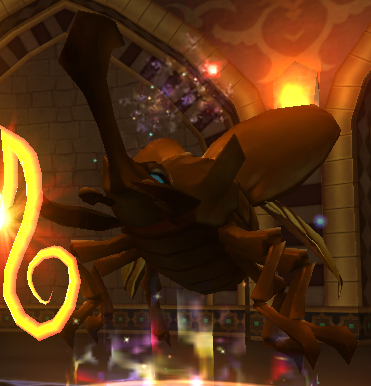
Dune Buggies are creatures your wizard encounters in the Alkali Barrows and the Tomb of the Forgotten. These fire creatures are bugs that live amongst the dunes. Any other associations are purely incidental.
A dune buggy — also known as a beach buggy — is a recreational off-road vehicle with large wheels, and wide tires, designed for use on sand dunes, beaches, off-road or desert recreation. The design is usually a topless vehicle with a rear-mounted engine. A dune buggy can be created by modifying an existing vehicle or custom-building a new vehicle.

For dune buggies built on the chassis of an existing vehicle, the Volkswagen Beetle has been most commonly used as the basis for the buggy, though conversions were made from other cars (such as the Corvair and Renault Dauphine). The model is nicknamed Bug, lending partial inspiration to the term “buggy.” The Beetle platform chassis was used because the rear engine layout improves traction, the air-cooled engine avoids the complexities and failure points associated with a water-cooled engine, the Beetle’s front torsion bar suspension was not only considered cheap and robust, but it was also extremely easy to alter and adjust its ride-height. Furthermore, spare parts — and donor vehicles themselves — were cheap and readily available. While early dune buggy conversions were left with no body, or featured custom bodies of sheet metal (such as the EMPI Sportsters and similar buggies), glass-reinforced plastic (fiberglass) bodies, developed in the 1960s, have become the standard image of the modern buggy, and come in many shapes and sizes.
The original fiberglass dune buggy was the 1964 “Meyers Manx” built by Bruce Meyers. Bruce Meyers designed his fiberglass bodies as a “kit car”, using the Volkswagen Beetle chassis. Many other companies worldwide have been inspired by the Manx, making similar bodies and kits.
As a child of the ’70s two of the more memorable dune buggies from my youth were Wonderbug and Speed Buggy.
Wonderbug is a segment of the first and second season of the American television series The Krofft Supershow, from 1976 to 1978. It was shot in Hollywood, Los Angeles, California. The show was rerun as part of ABC’s Sunday morning series.

Wonderbug’s alter ego “Schlepcar” (so named due to its personalized California license plate “SCHLEP”) was an old, beat up, conglomeration of several junked cars that looked like a rusty dune buggy. Like Herbie of The Walt Disney Company film fame, Schlepcar was alive and could drive itself, and could also talk in a mumbling voice. It was found in a junk yard by teenagers Barry Buntrock (David Levy), C.C. McNamara (John Anthony Bailey) and Susan Talbot (Carol Anne Seflinger). Schlepcar transformed into the shiny metal-flake orange Wonderbug (vocal effects provided by Frank Welker) whenever a magic horn (which played the bugle call for “cavalry charge”) was sounded. In his Wonderbug identity, Schlepcar had the power of flight and was able to help the three teens capture crooks and prevent wrongdoing.

In Wonderbug mode, the car was a Volkswagen-based Meyers Manx-clone body. Specifically the body was a Dune Runner manufactured by Dune Buggy Enterprises of Westminster, California. Dune Buggy Enterprises offered the Dune Runner with three different hood choices. Wonderbug has the T- Bird hood choice.
Speed Buggy is an American animated television series, produced by Hanna-Barbera, which originally aired for one season on CBS from September 8, 1973, to December 22, 1973. With the voices of Mel Blanc, Michael Bell, Arlene Golonka, and Phil Luther Jr., the show follows an orange anthropomorphic dune buggy who alongside teenagers Debbie, Mark, and Tinker, solves mysteries while participating in racing competitions around the world. The series was produced by Iwao Takamoto, executive produced by William Hanna and Joseph Barbera, and directed by Charles A. Nichols.
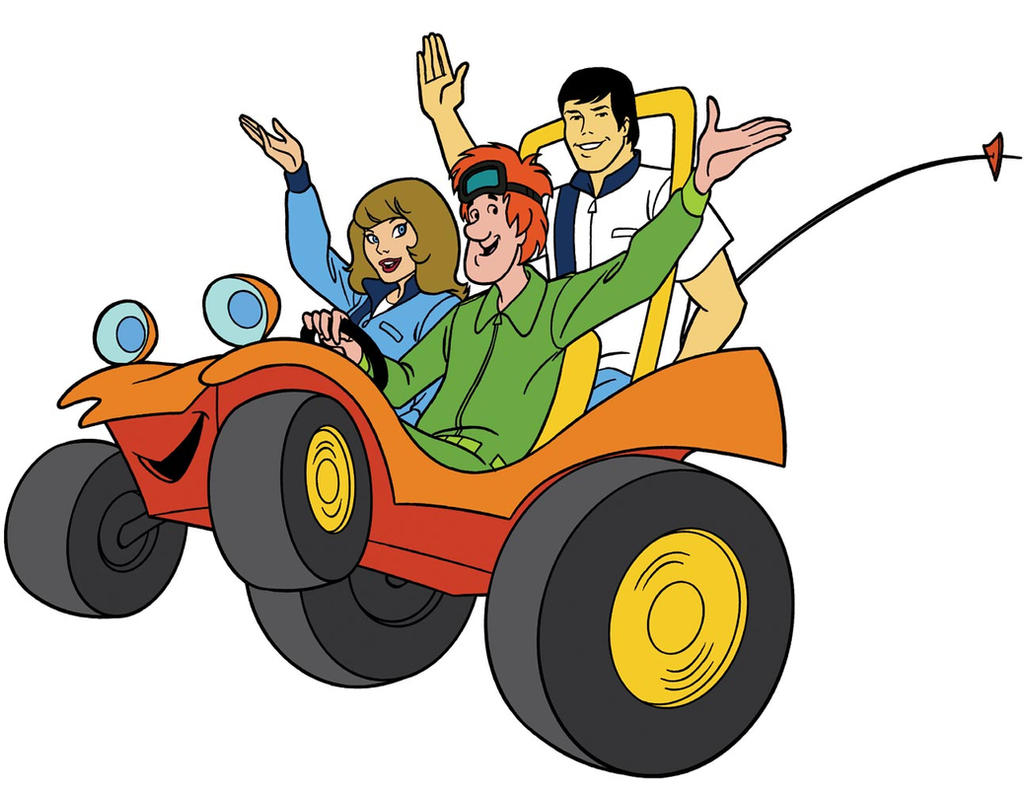
Set in an assortment of locations around the world, the series follows three teenagers (Mark, Debbie, and Tinker) and a talking dune buggy as they partake in various adventures. Speed Buggy, the dune buggy, was designed by Tinker and participates in racing competitions in order to collect winner’s trophies. During their travels, the crew often defeats villains and crooks in order to save the world, such as diamond thieves, car-obsessed doctors, and evil pirates. Known as the “Speed Buggs”, the group of three teenagers is able to activate Speed Buggy through the use of a portable walkie-talkie.
The current list of all the (known) Mirage references can be found here.
Although I am well versed in Pop Culture references but I do not claim to have caught them all. Let me know your favorites in the comments and if I’ve missed one you caught, let me know so I can add it to the list.
Text for this article is excerpted from the linked wiki pages
Dune Buggy image is from Wizard101, and is copyright of KingsIsle Entertainment
Myers-Manx dune buggy image is copyright by Roger D. Herzler. It is borrowed from Wikipedia and is shared under the CC BY-SA 3.0 Creative Commons license.
All Wonderbug images are copyright Sid and Marty Krofft Television Productions
Speed Buggy image is copyright Hanna-Barbera Productions
Image usage qualifies as fair use under US copyright law.
 Vulcan Stev's Database