Voltergeist – poltergeists and Poltergeist (1982)
https://wiki.wizard101central.com/wiki/Creature:Voltergeist
https://en.wikipedia.org/wiki/Poltergeist
https://en.wikipedia.org/wiki/Poltergeist_(1982_film)
https://youtu.be/E7nFf-ld7Fk

Voltergeists are created by the Myth Strand of the Paradox Chain. They like to settle into any equipment they find as the electricity makes them feel alive again. This particular Voltergeist has settled into Storm Turbine D. It is up to your wizard to remove it.
“So this is what it comes down to, huh? Chase me out of my Turbine just because my presence could spell meteorological disaster for thousands… Try to trap me in a shell filled with so … much delicious electricity … No, NO! I will not accept such a wonderful fate. I have only one thing to say to you and your tantalizingly zap tastic shell… BOO!!” – The Voltergeist
MONSTROLOGY TOME DESCRIPTION: A phantom figure drawn to raw Storm Energy. And sometimes pancakes.

In German folklore and ghostlore, a poltergeist (/ˈpoʊltərˌɡaɪst/ or /ˈpɒltərˌɡaɪst/; German: [ˈpɔltɐɡaɪ̯st] ⓘ; ‘rumbling ghost’ or ‘noisy spirit’) is a type of ghost or spirit that is responsible for physical disturbances, such as loud noises and objects being moved or destroyed. Most claims or fictional descriptions of poltergeists show them as being capable of pinching, biting, hitting, and tripping people. They are also depicted as capable of the movement or levitation of objects such as furniture and cutlery, or noises such as knocking on doors. Foul smells are also associated with poltergeist occurrences, as well as spontaneous fires and different electrical issues such as flickering lights.
These manifestations have been recorded in many cultures and countries, including Brazil, Australia, the United States, Japan and most European nations. The first recorded cases date back to the 1st century.

The word poltergeist comes from the German language words poltern ‘to make sound, to rumble’ and Geist ‘ghost, spirit’ and the term itself translates as ‘noisy ghost’, ‘rumble-ghost’ or a ‘loud spirit’. A synonym coined by René Sudre is thorybism, from the Ancient Greek θορυβείν (thorubeín) ‘to make noise or uproar, to throw into confusion’.
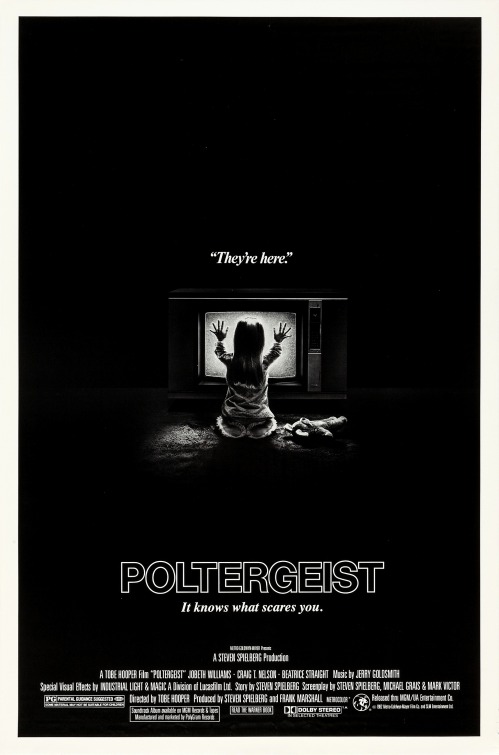
Poltergeist is a 1982 American supernatural horror film directed by Tobe Hooper and written by Steven Spielberg, Michael Grais and Mark Victor from a story by Spielberg. It stars JoBeth Williams, Craig T. Nelson, Beatrice Straight, and Heather O’Rourke and was produced by Spielberg and Frank Marshall. The film focuses on a suburban family whose home is invaded by malevolent ghosts that abduct their youngest daughter.
As Spielberg was contractually unable to direct another film while he made E.T. the Extra-Terrestrial, Hooper was selected based on his work on The Texas Chain Saw Massacre and The Funhouse. The origin of Poltergeist can be traced to Night Skies, which Spielberg conceived as a horror sequel to his 1977 film Close Encounters of the Third Kind; Hooper was less interested in the sci-fi elements and suggested they collaborate on a ghost story. Accounts differ as to the level of Spielberg’s involvement, but it is clear that he was frequently on set during filming and exerted significant creative control. For that reason, some have said that Spielberg should be considered the film’s co-director or even main director, though both Spielberg and Hooper have disputed this.
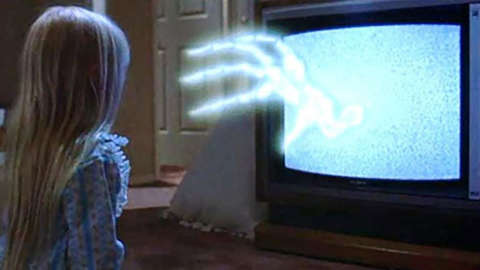
Released by Metro-Goldwyn-Mayer through MGM/UA Entertainment Co. on June 4, 1982, Poltergeist was a major critical and commercial success, becoming the eighth-highest-grossing film of 1982. In the years since its release, the film has been recognized as a horror classic. It was nominated for three Academy Awards, named by the Chicago Film Critics Association as the 20th-scariest film ever made, and a scene made Bravo’s 100 Scariest Movie Moments. Poltergeist also appeared at No. 84 on American Film Institute’s 100 Years…100 Thrills. The film was followed by Poltergeist II: The Other Side (1986), Poltergeist III (1988), as well as a 2015 remake, but none had the critical success of the original.
The current list of all the (known) Empyrea references can be found here.
Although I am well versed in Pop Culture references but I do not claim to have caught them all. Let me know your favorites in the comments and if I’ve missed one you caught, let me know so I can add it to the list.
Text for this article is excerpted from the linked wiki pages
The Voltergeist image is from Wizard101, and is copyright of KingsIsle Entertainment.
La Vie Mystérieuse cover image is borrowed from Wikipedia. It is in the public domain.
Poltergeist activity photo is borrowed from the HubPages article Ghosts, Category II, Poltergeists Part 1 authored by Gaurav Oberoi. No attribution is given at t he site. If this is your photo please let us know so we can credit you.
Poltergeist (1982) movie poster is borrowed from the Imp Awards. The poster and movie still are copyright MGM
Image usage qualifies as fair use under US copyright law.
 Vulcan Stev's Database