Rententen – Rin Tin Tin, Rintintin, Old Yeller, Underdog and a veiled reference to James Bond
https://wiki.wizard101central.com/wiki/Creature:Rententen
https://en.wikipedia.org/wiki/Rin_Tin_Tin
https://blog.imagesmusicales.be/lucky-stars-nenette-rintintin/
https://en.wikipedia.org/wiki/Old_Yeller_(film)
https://en.wikipedia.org/wiki/Underdog_(TV_series)
https://en.wikipedia.org/wiki/James_Bond

Rententen the legendary spy is a Marleybonian. He is a known criminal and master of disguise. He also defected to Polaris. Using his aliases of Corporal Yellman and Shoeshine, Rententen has been touting the Pingouin Revolution to rally the rank-and-file of Marleybone to overthrow the Queen and Usher in a golden age. His fiancée stopped listening to him at that point.
Rententen considers your wizard to be a rival worthy of his legend. He does not seem to grasp that spies are not supposed to be legendary but rather subtle and unknown. History MUST know that he has sown seeds of insurrection among the meager classes of the Spiral powers. He did it all for personal power and not at the behest of the Polaris government.
Rin Tin Tin or Rin-Tin-Tin (September 10, 1918 – August 10, 1932) was a male German Shepherd born in Flirey, France, who became an international star in motion pictures. He was rescued from a World War I battlefield by an American soldier, Lee Duncan.
Following advances made by American forces during the Battle of Saint-Mihiel, Corporal Lee Duncan, an armorer of the U.S. Army Air Service, was sent forward on September 15, 1918, to the small French village of Flirey to see if it would make a suitable flying field for his unit, the 135th Aero Squadron. The area had been subjected to aerial bombing and artillery fire, and Duncan found a severely damaged kennel which had once supplied the Imperial German Army with German Shepherd dogs. The only dogs left alive in the kennel were a starving mother with a litter of five nursing puppies, their eyes still shut because they were less than a week old. Duncan rescued the dogs and brought them back to his unit.
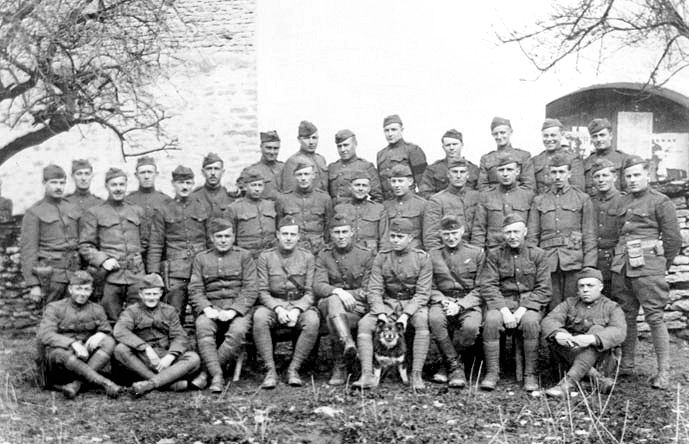
When the puppies were weaned, he gave the mother to an officer and three of the litter to other soldiers, but he kept one puppy of each sex. He felt that these two dogs were symbols of his good luck. He dubbed them Rin Tin Tin and Nanette after a pair of good luck charms called Rintintin and Nénette that French children often gave to the American soldiers
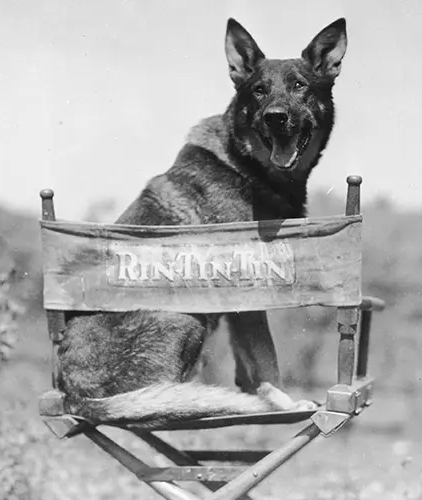
After the war, Duncan trained Rin Tin Tin and obtained silent film work for the dog. Rin Tin Tin was an immediate box-office success and went on to appear in 27 Hollywood films, gaining worldwide fame. Along with the earlier canine film star Strongheart, Rin Tin Tin was responsible for greatly increasing the popularity of German Shepherd dogs as family pets. The immense profitability of his films contributed to the success of Warner Bros. studios and helped advance the career of Darryl F. Zanuck from screenwriter to producer and studio executive.

After the dog’s only appearance in color (the 1929 musical revue The Show of Shows, in which he barks an introduction to a musical pageant), Warner Bros. dispensed with the services of both Rin Tin Tin and Lee Duncan. The studio was intent on promoting its “all-talking” stars, and silent-film personality Rin Tin Tin obviously couldn’t speak. Undaunted, Duncan sought further film work and signed with independent producer Nat Levine, who starred Rin Tin Tin in serials and feature films.
After Rin Tin Tin died in 1932, the name was given to several related German Shepherd dogs featured in fictional stories on film, radio, and television. Rin Tin Tin Jr. appeared in some serialized films, but was not as talented as his father. Rin Tin Tin III, said to be Rin Tin Tin’s grandson, but probably only distantly related, helped promote the military use of dogs during World War II. Rin Tin Tin III also appeared in a film with child actor Robert Blake in 1947. Duncan groomed Rin Tin Tin IV for the 1950s television series The Adventures of Rin Tin Tin, produced by Bert Leonard.

Nénette and Rintintin were tiny yarn dolls that took Paris by storm in 1918. Parisian ladies would pin them on their bodice as mascots to protect them from the bombs and shells. Men hung the two small talismans on their watch chain and soldiers would keep them in their knapsack. As is often the case with fetishes, the superstition was conditional: it would ward off danger only if the charming little dolls had been given, exchanged or received, but not purchased.
Old Yeller is a 1957 American Western drama film directed by Robert Stevenson and produced by Walt Disney. It stars Dorothy McGuire and Fess Parker, with Tommy Kirk, Kevin Corcoran, and Chuck Connors. It is about a boy and a stray dog in post-Civil War Texas. The film is based upon the 1956 novel of the same name by Fred Gipson. Gipson also co-wrote the screenplay along with William Tunberg.

Old Yeller was released on December 25, 1957, to critical acclaim, and was a commercial success, becoming the fifth highest-grossing film of 1957 and earning $6.25 million in the United States and Canada. The film’s success led to a 1963 sequel, Savage Sam, which was based on a 1962 book by Gipson. In 2019, the film was selected for preservation into the United States National Film Registry by the Library of Congress for being “culturally, historically, or aesthetically significant”.
Underdog, also known as The Underdog Show, is an American Saturday morning animated television series that ran from October 3, 1964, to March 4, 1967, starting on the NBC network until 1966, with the rest of the run on CBS, under the primary sponsorship of General Mills, for a run of 62 episodes. It is one of the early Saturday morning cartoons. The show continued in syndication until 1973.

Underdog, Shoeshine Boy’s heroic alter ego, appears whenever love interest Sweet Polly Purebred is being victimized by such villains as Simon Bar Sinister or Riff Raff. Underdog nearly always speaks in rhyming couplets, as in “There’s no need to fear, Underdog is here!” His voice was supplied by Wally Cox. When appearing as Shoeshine Boy, he described himself as “humble, and loveable”.
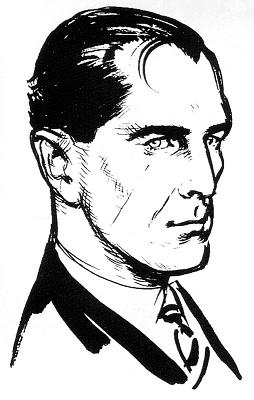
James Bond, the legendary spy also known by the code number 007 (pronounced “double-oh-seven”)—has also been adapted for television, radio, comic strips, video games and film. The James Bond franchise is one of the highest-grossing media franchises of all time. Ian Fleming created the fictional character of James Bond as the central figure for his works. Bond is an intelligence officer in the Secret Intelligence Service, commonly known as MI6. Bond is known by his code number, 007, and was a Royal Naval Reserve Commander. Fleming based his fictional creation on a number of individuals he came across during his time in the Naval Intelligence Division and 30 Assault Unit during the Second World War, admitting that Bond “was a compound of all the secret agents and commando types I met during the war”. One of the spy’s traits is that he is well-known wherever he goes, hence his legendary status.
The current list of all the (known) Novus references are located here.
Although I am well versed in Pop Culture references but I do not claim to have caught them all. Let me know your favorites in the comments and if I’ve missed one you caught, let me know so I can add it to the list.
Text for this article is excerpted from the linked wiki pages
Rententen image is from Wizard101, and is copyright of KingsIsle Entertainment.
135th Aero Squadron image is borrowed from Wikipedia it is in the Public Domain.
Rin Tin Tin image is borrowed from FoxNews.com it appears to be in the Public Domain.
Where the North Begins (Warner Bros. 1923) movie poster is borrowed from Wikipedia it is in the Public Domain
Rintintin an Nenette ad is borrowed from the Images Musicales blog it appears to be in the public domain.
Olde Yeller (Walt Disney 1957) is borrowed from Wikipedia, it is copyright Walt Disney Pictures.
Shoeshine Boy/Underdog image is a combo image by Alien Graphics sourced from internet searches. Underdog is owned and copyright by Classic Media / Universal Television.
James Bond sketch is borrowed from Wikipedia it is copyright The Daily Express.
Image usage qualifies as fair use under US copyright law.
 Vulcan Stev's Database