Huntsman Spiders – Huntsman spiders, members of the family Sparassidae and Toad from Nintendo’s Mario franchise
https://wiki.wizard101central.com/wiki/Creature:Huntsman_Spider_(Life)
https://wiki.wizard101central.com/wiki/Creature:Huntsman_Spider_(Balance)
https://en.wikipedia.org/wiki/Huntsman_spider
https://en.wikipedia.org/wiki/Toad_(Mario)
Luigi De Mario is trying to muscle folks like Ned Collie off their land. Townies are running out of Dream Water to sell and are looking for something else to bolster the tourist trade. Luigi is using corrupt Judges to force folks off their land so he can build an amusement park. After your wizard stops this plan, Luigi and his allies refurbish an Armada Sky Station into the “Doom Moon” to blow up Novus and anger Dasein.

Matilda Collie: “I told you to get, you lousy neigh-sayer. These are my hostages and they ain’t leavin’ just cause Prince Mario says so.”
Luigi di Mario: “Yawn Sorry, threats, boring. Toadies, eat-wait… wait one second. Is that the Wizard? THE Wizard? The one my little bro is always whining about? Luigi di Mario, Prince of House Mario, at your service. Well, I say service. I know, I know, people often go blind basking in my presence. But don’t, we’ve got stuff. Honor and all that. You offended the family Mario on Novus, so I plumbed the depths of a fallen world for toadies…”
Huntsman Toadie: “That’s us.”
Huntsman Spiders are encountered multiple times throughout Wallaru. Only Luigi di Mario refers to them as his Toadies.
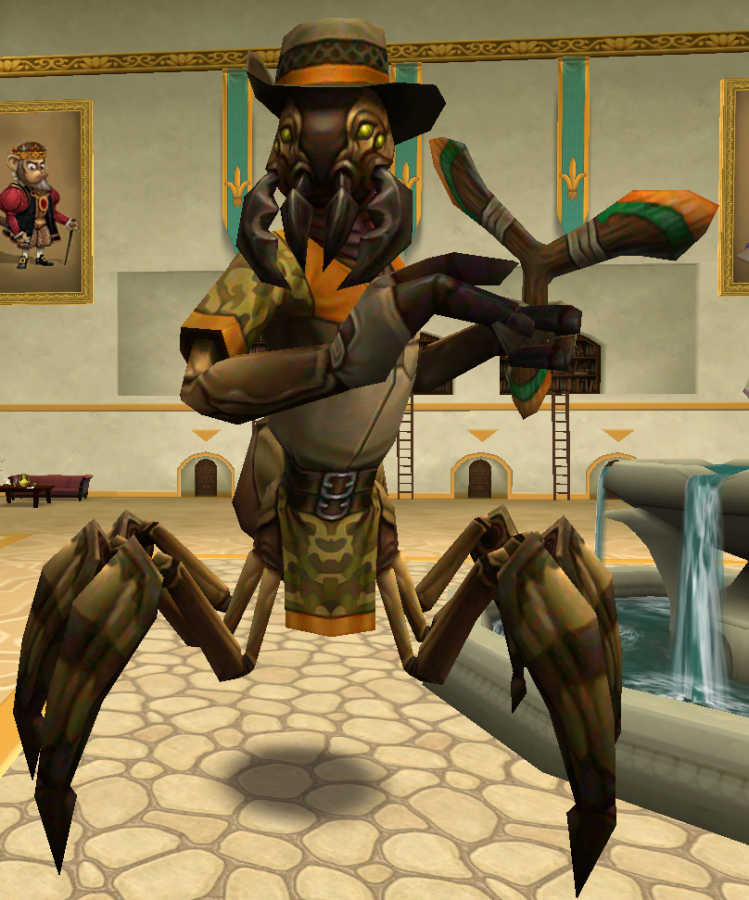
In Monquistan Embassy, Huntsman Spider (Balance) is considered a Boss. The Huntsman Spider (Life) is considered a Minion
In Kanga Guru Shrine, Huntsman Spiders (Balance & Life) are considered Minions to Zolomon.
In Demolition Tunnels, Huntsman Spiders (Balance & Life) are considered Minions to Economy Judge Decker.
In Hostage Cave, Huntsman Spiders (Balance & Life) are considered Minions to Luigi di Mario.
Monstrology Tome Description
Huntsman Spider Balance
Hunts the most dangerous game: Man. Or so it hoped. Turns out Man just shrieks and runs at the first sign of it.
Huntsman Spider Life
Even spiders can appreciate the sport of kings: sitting idly in the woods until a herbivore haplessly crosses your path.

Huntsman spiders, members of the family Sparassidae (formerly Heteropodidae), catch their prey by hunting rather than in webs. They are also called giant crab spiders because of their size and appearance. Larger species sometimes are referred to as wood spiders, because of their preference for woody places (forests, mine shafts, woodpiles, wooden shacks). In southern Africa the genus Palystes are known as rain spiders or lizard-eating spiders. Commonly, they are confused with baboon spiders from the Mygalomorphae infraorder, which are not closely related.
More than a thousand Sparassidae species occur in most warm temperate to tropical regions of the world, including much of Australia, Africa, Asia, the Mediterranean Basin, and the Americas.

Sparassids are eight-eyed spiders. The eyes appear in two largely forward-facing rows of four on the anterior aspect of the prosoma. Many species grow very large – in Laos, male giant huntsman spiders (Heteropoda maxima) attain a legspan of 25–30 centimeters (9.8–11.8 in). People unfamiliar with spider taxonomy commonly confuse large species with tarantulas, but huntsman spiders can generally be identified by their legs, which, rather than being jointed vertically relative to the body, are twisted in such a way that in some attitudes the legs extend forward in a crab-like fashion. It is also commonly confused for a brown recluse spider, due to their shared coloring. However, brown recluse venom is significantly dangerous to humans, while that of the huntsman spider is less so.
Species native to Australia:
Beregama — Australia, Papua New Guinea
Delena — Australia, New Zealand
Holconia — Australia
Irileka — Australia
Isopeda — Australia, Philippines, Papua New Guinea
Isopedella — Australia, Papua New Guinea, Indonesia
Keilira — Australia
Neosparassus — Australia
Typostola — Australia, Papua New Guinea
Yiinthi -Australia, Papua New Guinea
Zachria — Australia
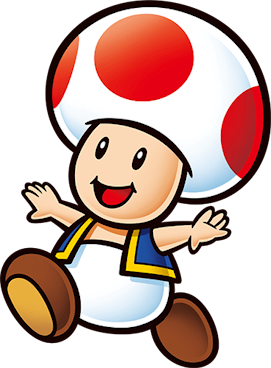
Toad, known in Japan as Kinopio, is a character created by Japanese video game designer Shigeru Miyamoto for Nintendo’s Mario franchise. A prominent red Toad serves as one of Princess Peach’s handlers and appears consistently as a supporting character in the franchise.
While most Toads look virtually identical to each other and usually are not named individually, notable exceptions include Captain Toad, Toadette and Toadsworth. The most prominent trait of the Toads is their large, mushroom-like head with colored spots on top.
The Toads typically have assisting roles in the Mario franchise, but are occasionally featured as protagonists. A blue Toad and yellow Toad are most featured Toads as playable characters along with Mario and Luigi in New Super Mario Bros. Wii, New Super Mario Bros. U and Super Mario Bros. Wonder. The blue Toad also returns as one of the playable characters in Super Mario 3D World. Captain Toad: Treasure Tracker featured Captain Toad as the main character, and was the first game to have a Toad as the titular character.
The current list of all the (known) Wallaru references are located here.
Although I am well versed in Pop Culture references but I do not claim to have caught them all. Let me know your favorites in the comments and if I’ve missed one you caught, let me know so I can add it to the list.
Text for this article is excerpted from the linked wiki pages
Huntsman Spider images are from Wizard101, and are copyright of KingsIsle Entertainment.
Sparassidae Isopedella cana. image is borrowed from Wikipedia. It is copyright Loxley Fedec and is shared under the CC BY-SA 4.0 Creative Commons act.
Sparassidae Neosparassus diana image is borrowed from Wikipedia. It is copyright Donald Hobern and is shared under the CC BY 2.0 Creative Commons act.
Toad artwork is borrowed from Wikipedia and is copyright Nintendo
Image usage qualifies as fair use under US copyright law.
 Vulcan Stev's Database