Phantasmanian Devil – Taz, the Tasmanian Devil and The Tasmanian devil (Sarcophilus harrisii)
https://wiki.wizard101central.com/wiki/Creature:Phantasmanian_Devil_(Star)
https://en.wikipedia.org/wiki/Tasmanian_Devil_(Looney_Tunes)
https://en.wikipedia.org/wiki/Tasmanian_devil
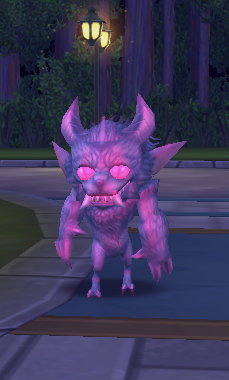
Your wizard is on the trail of Mr. Cane. After helping Judge Rozzer and Judge Nelson, Judge Lawless points you in the direction of the resort’s Admin Offices. Mr. Cane is trapped in the office with these wretched, underformed, phantasmagorical curs. Your reward for rescuing Mr. Cane from the Phantasmanian Devils is a coupon for one discounted room during the off-season.
The Tasmanian Devil (also spelled Tazmanian Devil), commonly referred to as “Taz”, is an animated cartoon character featured in the Warner Bros. Looney Tunes and Merrie Melodies series of cartoons. Though the character appeared in only five shorts before Warner Bros. Cartoons shut down in 1964, marketing and television appearances later propelled Taz to new popularity throughout the 1990s.

Taz is generally portrayed as a ferocious, albeit dim-witted, carnivore with a notoriously short temper and little patience. In the short Ducking the Devil, he is described as a “vicious, evil-tempered brute with jaws like a steel trap”. Though he can be very devious, he is also sweet at times. His enormous appetite seems to know no bounds, as he will eat anything in his path. He is best known for his speech consisting mostly of grunts, growls, and rasps (in his earlier appearances, he does speak English with primitive grammar) as well as his ability to spin like a vortex and bite through nearly anything. While in motion, he’s often depicted as a spinning tornado, drilling himself through trees or soil. Taz does have one weakness: he can be calmed by almost any music. While in this calm state, he can be easily dealt with. The only music known not to pacify Taz is the bagpipes, which he finds insufferable.
In his first appearance in McKimson’s Devil May Hare (first released on June 19, 1954), Taz stalks Bugs Bunny, but due to his dimwittedness and inability to frame complete sentences, he serves as little more than a nuisance. Bugs eventually gets rid of him in the most logical way possible: matching him up with an equally insatiable Tasmanian She-Devil. The character’s speech, a deep, gravelly voice peppered with growls, screeches, and raspberries, is provided by Mel Blanc. Blanc once stated that he created Taz’s voice because no one knew what real Tasmanian devils looked or sounded like at the time. Only occasionally would Taz actually speak, usually to utter some incongruous punchline (e.g. “What for you bury me in the cold, cold ground?”), and yet the character is capable of writing and reading. A running gag is that when Bugs Bunny hears of the approach of Taz, he looks him up in an encyclopedia and starts reading off a list of animals that Taz eats (which is pretty much everything that exists, including “people”). Bugs finds “rabbits” not listed until Taz enters and either points out that “rabbits” are listed or writes rabbits on the list.
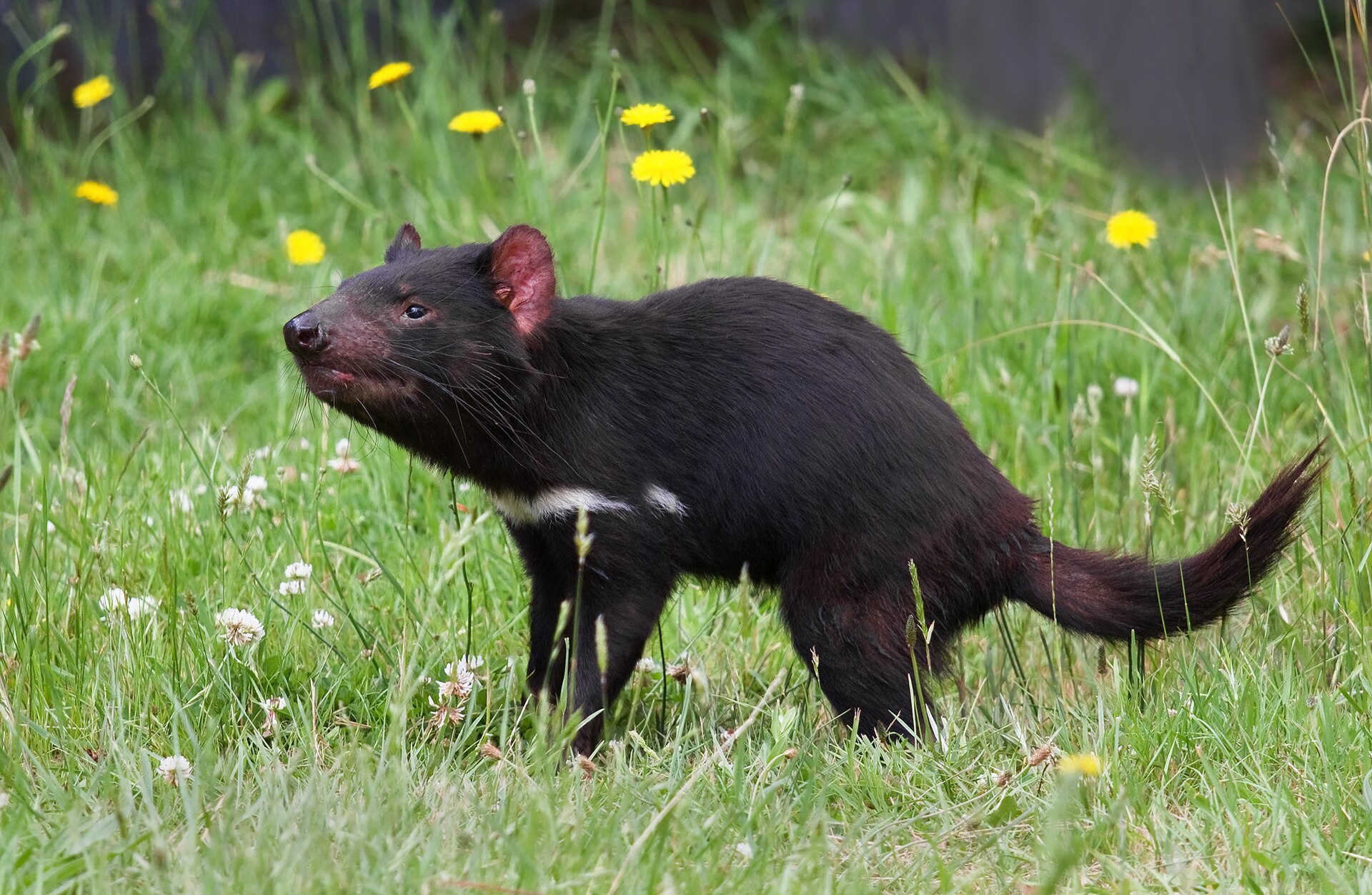
The Tasmanian devil (Sarcophilus harrisii; palawa kani: purinina) is a carnivorous marsupial of the family Dasyuridae. It was formerly present across mainland Australia, but became extinct there around 3,500 years ago; it is now confined to the island of Tasmania. The size of a small dog, the Tasmanian devil became the largest carnivorous marsupial in the world following the extinction of the thylacine in 1936. It is related to quolls, and distantly related to the thylacine. It is characterized by its stocky and muscular build, black fur, pungent odor, extremely loud and disturbing screech, keen sense of smell, and ferocity when feeding. The Tasmanian devil’s large head and neck allow it to generate among the strongest bites per unit body mass of any extant predatory land mammal. It hunts prey and scavenges on carrion.
Although devils are usually solitary, they sometimes eat and defecate together in a communal location. Unlike most other dasyurids, the devil thermoregulates effectively, and is active during the middle of the day without overheating. Despite its rotund appearance, it is capable of surprising speed and endurance, and can climb trees and swim across rivers. Devils are not monogamous. Males fight one another for females, and guard their partners to prevent female infidelity. Females can ovulate three times in as many weeks during the mating season, and 80% of two-year-old females are seen to be pregnant during the annual mating season.
In 1941, devils became officially protected. Since the late 1990s, the devil facial tumor disease (DFTD) has drastically reduced the population and now threatens the survival of the species, which in 2008 was declared to be endangered. Starting in 2013, Tasmanian devils are again being sent to zoos around the world as part of the Australian government’s Save the Tasmanian Devil Program. The devil is an iconic symbol of Tasmania and many organizations, groups and products associated with the state use the animal in their logos. It is seen as an important attractor of tourists to Tasmania and has come to worldwide attention through the Looney Tunes character of the same name.
The current list of all the (known) Wallaru references are located here.
Although I am well versed in Pop Culture references but I do not claim to have caught them all. Let me know your favorites in the comments and if I’ve missed one you caught, let me know so I can add it to the list.
Text for this article is excerpted from the linked wiki pages
Phantasmanian Devil image is from Wizard101, and is copyright of KingsIsle Entertainment.
Taz image is borrowed from Wikipedia and is copyright Warner Bros.
Tasmanian Devil image is borrowed from Wikipedia. It is copyright JJ Harrison and is shared under the CC BY-SA 3.0 Creative Commons License.
Image usage qualifies as fair use under US copyright law.
 Vulcan Stev's Database