Kangaroo Bushwhackers – Bushwhackers
https://wiki.wizard101central.com/wiki/Creature:Kangaroo_Bushwhacker_(Life)
https://wiki.wizard101central.com/wiki/Creature:Kangaroo_Bushwhacker_(Balance)
https://en.wiktionary.org/wiki/bushwhacker
https://en.wikipedia.org/wiki/The_Bushwhackers
https://en.wikipedia.org/wiki/The_Bushwackers_(band)
https://en.wikipedia.org/wiki/Bushwhacker
https://en.wikipedia.org/wiki/Bushwacker_(comics)

Thank you to JM Lacanlale for pointing me in the right direction.
Krokodile Dundara has agreed to clandestinely escort your Wizard out of Hope Springs into the outback. On your way to Dundara’s basecamp in a dark and sinister alley, you are sidetracked by Kangaroo Bushwhackers. They’re after Krokodile Dundara.
Dundara’s nemesis, The Krokodile Hunter, has sent the Bushwhackers to defeat the outdoorsman and assure the Krokodile Hunter’s long-awaited victory once and for all. But the Bushwhackers don’t seem all that thrilled to be fighting your wizard instead of Krokodile Dundara.
Bushwhacker – Noun:
(Australia) A person who lives in the bush, especially as a fugitive; a person who clears woods and bush country.
(US, historical) A guerrilla (of either side) during the American Civil War.
Someone who attacks without warning.
The Bushwhackers were a professional wrestling tag team who competed first as the New Zealand Kiwis and then as The Sheepherders during their 36-year career as a tag team. They wrestled in the World Wrestling Federation, Jim Crockett Promotions, and on the independent territorial wrestling circuits. The Bushwhackers consisted of Butch Miller and Luke Williams. Williams and Miller were inducted into the WWE Hall of Fame class of 2015, and the Professional Wrestling Hall of Fame and Museum in 2020.
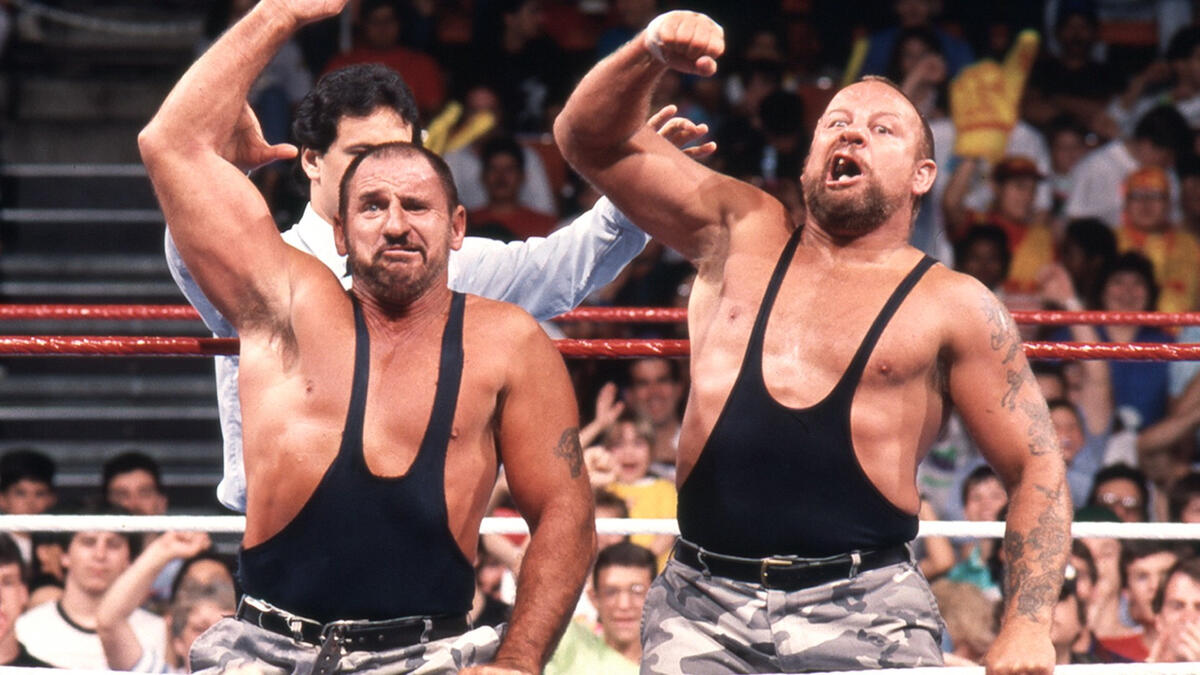
In December 1988, Williams and Miller debuted with the WWF in the midst of its aggressive national expansion. The team’s name was changed to The Bushwhackers and developed a more comedic style. The comedy act involved licking (each other, fans, and even their opponents), as well as using their existing distinctive march, swinging their flexed arms. The Bushwhackers made their debut on a matinee house show on December 26, 1988, facing The Bolsheviks.
The Bushwackers Band, often simply the Bushwackers, are an Australian folk and country music band or bush band founded in 1970. Their cover version of “And the Band Played Waltzing Matilda” (1976) was listed in the APRA Top 30 Australian songs in 2001, alongside its writer Eric Bogle’s 1980 rendition. Their top 60 studio albums on the Australian Kent Music Report are Bushfire (1978), Dance Album (1980), Faces in the Street and Beneath the Southern Cross (both 1981).

The Bushwackers Band were formed as the Original Bushwhackers and Bullockies Bush Band in 1970 in Melbourne by Dave Isom on guitar, banjo, vocals and mandolin; Bert Kahanoff on lagerphone and vocals; and Jan Wositzky on vocals, harmonica, banjo and percussion. Isom had started the La Trobe University Folk Club in 1969 and saw a concert by the Wild Colonial Boys at The Assembly Hall, Melbourne, with Kahanoff. Isom was inspired to form his own group, its name derives from a recording, Bullockies, Bushwhackers and Booze (1967) by various artists including Martyn Wyndham-Read, Peter Dickie and Jim Buchanan. Early gigs were in October 1971 by the trio who were later joined by various players, including Mick Slocum on accordion, concertina and vocals; and fiddlers Tony Hunt and Dave Kidd. Their debut album, The Shearers Dream, appeared in 1974 via Picture Records with the line-up of Hunt, Isom, Slocum and Wositsky joined by Dobe Newton on lagerphone, whistle and vocals.
The ensemble shortened their name to the Bushwackers Band and went full-time with their first tour to the United Kingdom. With an ever-changing line-up, and adding tin whistle, harmonica, concertina, 5-string banjo, bodhrán, bones, spoons, electric bass and guitar and drums the band worked throughout Australia and Europe. Their second album, And the Band Played Waltzing Matilda (1976), had Pete Howell on bass guitar joining the line-up of Hunt, Kidd, Newton, Slocum and Wositzky. It featured their cover version of the title song, which was written by Scottish-born Eric Bogle. “And the Band Played Waltzing Matilda” by the Bushwackers Band, alongside Bogle’s 1980 rendition, was listed as one of the APRA Top 30 Australian songs in 2001 as part of the celebrations for the Australasian Performing Right Association (APRA)’s 75th anniversary.

(from left to right) Arch Clements, Dave Pool, and Bill Hendricks brandishing revolvers
Bushwhacking was a form of guerrilla warfare common during the American Revolutionary War, War of 1812, American Civil War and other conflicts in which there were large areas of contested land and few governmental resources to control these tracts. This was particularly prevalent in rural areas during the Civil War where there were sharp divisions between those favoring the Union and Confederacy in the conflict. The perpetrators of the attacks were called bushwhackers. The term “bushwhacking” is still in use today to describe ambushes done with the aim of attrition.
Bushwhackers were generally part of the irregular military forces on both sides. While bushwhackers conducted well-organized raids against the military, the most dire of the attacks involved ambushes of individuals and house raids in rural areas. In the countryside, the actions were particularly inflammatory since they frequently amounted to fighting between neighbors, often to settle personal accounts.
The term “bushwhacker” came into wide use during the American Civil War (1861–1865). It became particularly associated with the pro-Confederate secessionist guerrillas of Missouri, where such warfare was most intense. Guerrilla warfare also wracked Kentucky, Tennessee, northern Georgia, Arkansas, and western Virginia (including the new state of West Virginia), among other locations.
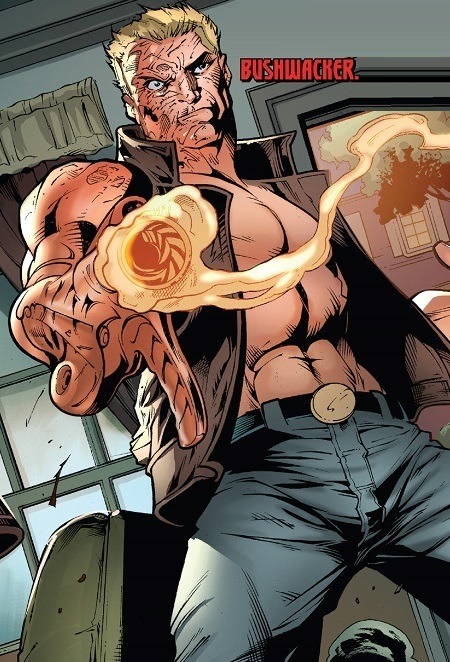
Carl Burbank is a supervillain appearing in American comic books published by Marvel Comics. Created by writer Ann Nocenti and artist Rick Leonardi, the character first appeared in Daredevil #248 (November 1987). Burbank is known under the codename Bushwacker. He is a recurring antagonist of the superhero Daredevil and has also encountered Punisher, Wolverine, and Carnage.
Once a priest, he renounced his vows after a series of deaths in his parish and became an assassin for the CIA. Equipped with cybernetic, weaponized arms, he later took on contracts from major crime figures such as Kingpin and The Hood. Burbank is also a mutant, a subspecies of humans born with superhuman abilities.
Carl Burbank was bionically modified by the CIA, transforming him into a cyborg. Although he appears fully human, his body is coated with a flesh-like substance that can liquefy to seal wounds, making him resistant to gunfire and able to conceal scars. He can morph his arms into various weapons, including a rifle, handgun, assault rifle, buzzsaw, and flamethrower, and has even fired cyanide capsules. Bushwacker sometimes consumes ammunition to fuel his weapon, occasionally seen ingesting gasoline or bullets, though at other times, he appears to have an unlimited supply. He was once severely burned, leaving scars that periodically reappear on his face—though he can alter his appearance to either reveal or conceal them at will. Bushwacker is able to use highly concussive energy weaponry (similar to that of Iron Man).
The current list of all the (known) Wallaru references are located here.
Although I am well versed in Pop Culture references but I do not claim to have caught them all. Let me know your favorites in the comments and if I’ve missed one you caught, let me know so I can add it to the list.
Text for this article is excerpted from the linked wiki pages
Kangaroo Bushwhacker image is from Wizard101, and is copyright of KingsIsle Entertainment.
Bushwhackers image is borrowed from the WWE Website and is copyright the WWE.
The Bushwackers image is borrowed from Wikipedia. It is copyright Peterdownunder and is shared under the CC BY-SA 3.0 Creative commons license.
Bushwhackers images is borrowed from Wikipedia courtesy of the Red River Historical Museum, Sherman, Texas. It is in the public domain.
Bushwacker image is copyright Marvel Comics.
Image usage qualifies as fair use under US copyright law.
 Vulcan Stev's Database