Taweret – Taweret, the Egyptian goddess of childbirth and fertility.
https://wiki.wizard101central.com/wiki/Creature:Taweret
https://en.wikipedia.org/wiki/Taweret
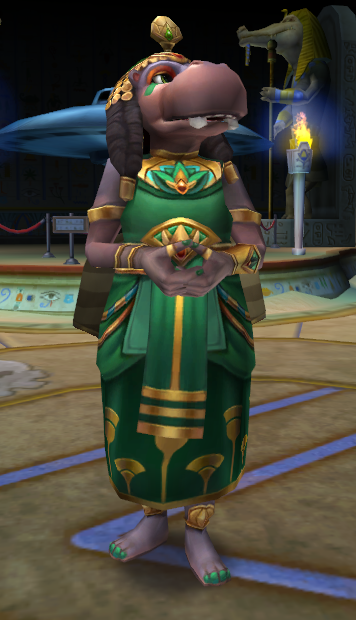
Taweret was an Avatar of Khonsu. The Taweret that your wizard fights is not the actual Taweret. She is in fact a myth created by the Bard, a myth crashing against reality. She is but a tool wielded by a clumsy craftsman.
Taweret: “I AM TAWERET!”
Brother Flare: “Wow. Actual hippo. Didn’t see that coming.”
Taweret: “WHAT ELSE WOULD YOU EXPECT IN A MUSEUM DEDICATED TO MY GREAT WORKS?”
Brother Flare: “You can hear me?”
Taweret: “I HEAR ALL!”
Brother Flare: “Then hear this: for the crimes you committed in the name of your false king, the Covenant of Ra shall pass sentence upon you! Go get ’em, Wizard!”
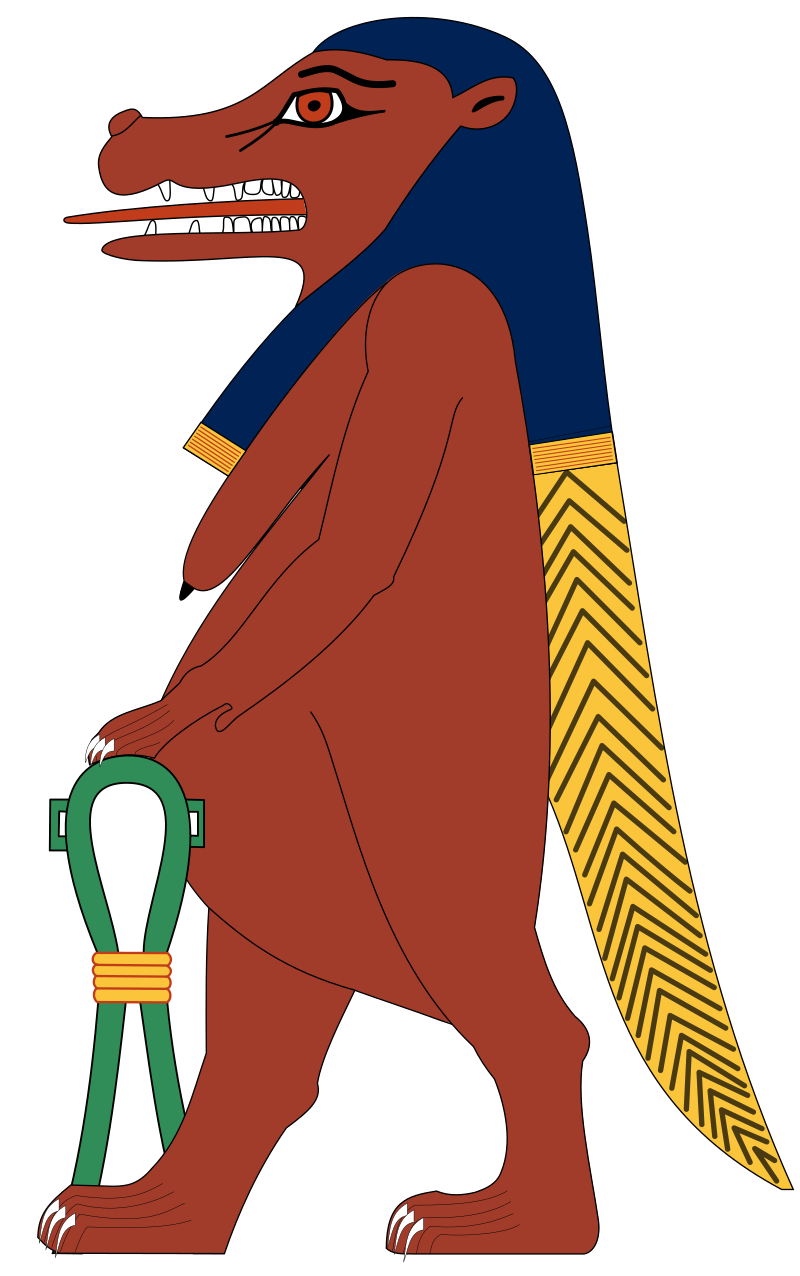
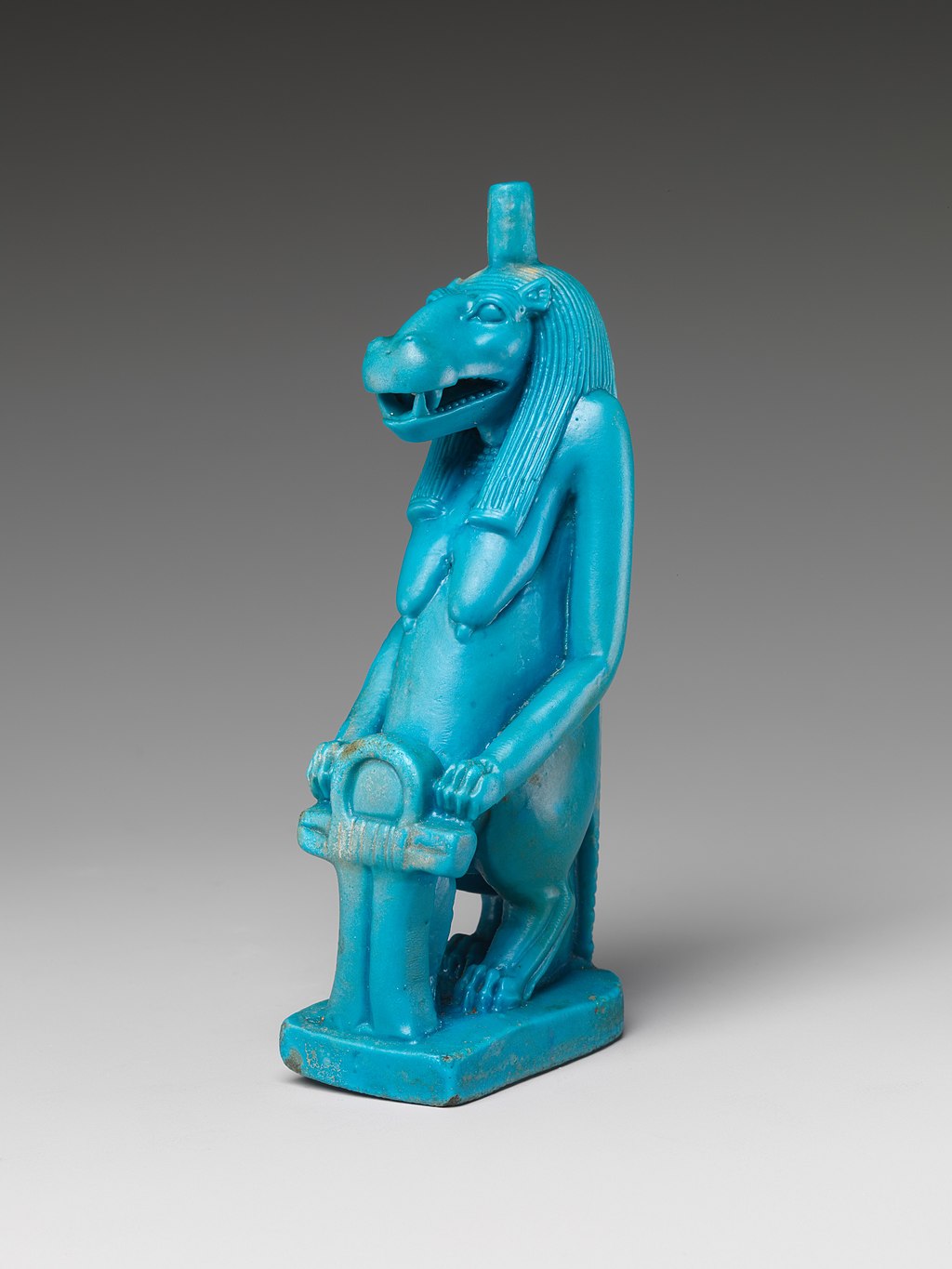
In Ancient Egyptian religion, Taweret (Ancient Egyptian: tꜣ-wrt, also spelled Taurt, Tuat, Tuart, Ta-weret, Tawaret, Twert and Taueret, and in Ancient Greek: Θουέρις, romanized: Thouéris, Thoeris, Taouris and Toeris) is the protective goddess of childbirth and fertility. The name “Taweret” means “she who is great” or simply “great one”, a common pacificatory address to dangerous deities. The deity is typically depicted as a bipedal female hippopotamus with feline attributes, pendulous female human breasts, the limbs and paws of a lion, and the back and tail of a Nile crocodile. She commonly bears the epithets “Lady of Heaven”, “Mistress of the Horizon”, “She Who Removes Water”, “Mistress of Pure Water”, and “Lady of the Birth House”.
Although Ipet (aka Apet or Aptet) is mentioned in the Old Kingdom Pyramid Texts, and Taweret is seen frequently on Middle Kingdom ritual objects, hippopotamus goddesses did not gain a significant role in Egyptian mythology until the New Kingdom (c. 1550–1069 BCE). Taweret is featured in some versions of a popular and widespread myth in which the Eye of Ra becomes angry with her father and retreats to Nubia in the form of a lioness. Upon the Eye of Ra’s eventual return to Egypt, she assumes the form of a hippopotamus (presumably Taweret) and consequently brings the flooding of the Nile. This myth demonstrates Taweret’s primary function as a goddess of fertility and rejuvenation. Some scholars feel that her role in the Nile inundation is one of the reasons she was given the epithet “Mistress of Pure Water”. However, her similar role in the rejuvenation of the dead also cannot be overlooked with regards to this epithet – just as she provided life for the living through physical birth and the inundation, she also cleansed and purified the dead so they could pass safely into the afterlife.
In the New Kingdom Taweret’s image was frequently used to represent a northern constellation in zodiacs. This image is attested in several astronomical tomb paintings, including the Theban tombs of Tharwas (tomb 353), Hatshepsut’s famed advisor Senenmut (tomb 232), and the pharaoh Seti I (KV17) in the Valley of the Kings. The image of this astral Taweret appears almost exclusively next to the Setian foreleg of a bull. The latter image represents the Big Dipper and is associated with the Egyptian god of chaos, Seth. The relationship between the two images is discussed in the Book of Day and Night (a cosmically focused mythological text from the Twentieth Dynasty, c. 1186–1069 BCE) as follows: “As to this foreleg of Seth, it is in the northern sky, tied down to two mooring posts of flint by a chain of gold. It is entrusted to Isis as a hippopotamus guarding it.” Although the hippopotamus goddess is identified in this text as Isis, not Taweret, this phenomenon is not uncommon in later periods of Egyptian history. When assuming a protective role, powerful goddesses like Isis, Hathor, and Mut assumed the form of Taweret, effectively becoming a manifestation of this goddess. Likewise, Taweret gradually absorbed qualities of these goddesses and is commonly seen wearing the Hathoric sun disc that is iconographically associated with both Hathor and Isis.
The current list of all the (known) Krokotopia references can be found here.
Although I am well versed in Pop Culture references but I do not claim to have caught them all. Let me know your favorites in the comments and if I’ve missed one you caught, let me know so I can add it to the list.
Text for this article is excerpted from the linked wiki pages
Taweret Statue image is Wizard101, and is copyright of KingsIsle Entertainment.
Taweret drawing is borrowed from Wikipedia. It is copyright Jeff Dahl and is shared under the CC BY-SA 4.0 Creative Commons license.
Faience statuette of Taweret image is borrowed from Wikipedia and was donated to Wikimedia Commons as part of a project by the Metropolitan Museum of Art. It is in the public domain by way of the Creative Commons CC0 1.0 Universal Public Domain Dedication.
Image usage qualifies as fair use under US copyright law.
 Vulcan Stev's Database