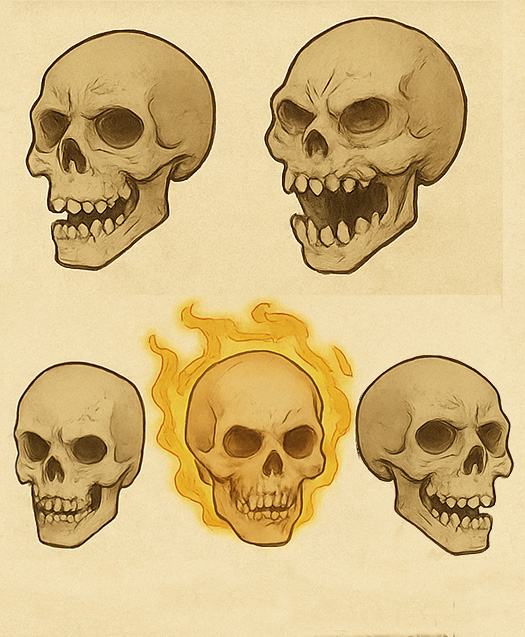
Five Sentient Skulls developed for my DM. After we’ve been in-world for a number of sessions the backstory is starting to flesh out. Imagine my surprise to discover that these original five skulls were part of something greater. They aren’t just magical undead creatures in a haunted mansion, they are an intrinsic part of the lore of our setting.

Dai’Lekh’s Early Hypothesis
Dai’Lekh believed that the failure of lichdom—and of nearly every known soul-binding discipline—did not stem from flawed spellcraft. The incantations were sound. The circles precise. The runes ancient and proven. The problem, he concluded, was the vessel.
“The flesh rots. The crystal fractures. The phylactery invites theft.
The skull endures.”
—Fragment recovered from a cracked soul-ledger
To Dai’Lekh, the skull represented more than bone. It was the final and most honest seat of identity: the chamber that once housed memory, will, fear, desire, and thought. He theorized that a soul bound directly to its own skull would remain closer to itself—less strained, less distorted—than one imprisoned in foreign matter or abstract containers.
Such a binding, he believed, would preserve selfhood, avoid the madness brought on by dissociation, and require far less continual magical reinforcement than traditional phylacteries. The soul would not be stored so much as settled.
He was… only partially correct.
The Experiments (Why There Are So Many)
The sentient skulls that now circulate through vaults, shops, ruins, and private collections are not accidents. They are successful failures.
Each skull was once a humanoid subject—volunteer, condemned criminal, cultist, assistant, rival, or so-called “temporary labor.” In every case, the soul was successfully anchored. The binding held. Identity remained intact. Consciousness persisted.
The body, however, did not.
In the process of anchoring the soul to the skull alone, the rest of the vessel proved unnecessary—or incompatible—and was lost, discarded, or simply failed to matter. What Dai’Lekh sought as permanence instead produced something subtler: stable sentience without continuation.
The results were consistent. The skulls retained awareness and personality. They spoke, remembered, judged, resented, advised. But they could not advance beyond a certain metaphysical depth. They were not liches. Not ghosts. Not constructs.
They were something new—and unfinished.
Why They Are Minor Undead (and Not World-Enders)
Dai’Lekh’s critical limitation became clear only after dozens of iterations: the soul could be anchored, but it could not be expanded.
Once bound to the skull, the soul was fixed at the point of its making. It could accumulate memories, develop opinions, and gain perspective, but it could not meaningfully increase its arcane capacity or existential reach. Power stagnated. Growth ceased.
Thus some skulls are brilliant yet helpless, their minds sharp but their influence minimal. Some are cowardly, having learned caution without ever learning courage. Some are bitter, trapped forever in the moment they realized what had been done to them. Others, disturbingly, are content—perfectly satisfied as shelf décor with an audience.
This constraint makes them invaluable sources of lore and counsel without threatening the balance of the world. They know, but they cannot do.
Why Dai’Lekh Abandoned the Skull Path
The flaw that doomed the project was what Dai’Lekh originally named Mobility of Will and became the Warforged Monstrosities.
A soul bound to a skull can observe endlessly. It can advise, persuade, and manipulate socially. It can whisper truths, half-truths, and lies with equal ease. But it cannot impose itself upon the world. It cannot act with final authority.
Dai’Lekh did not seek eternity merely to watch. He wanted dominion.
And so the skull path was abandoned in favor of more ambitious horrors: distributed phylacteries, soul lattices, conscience-bound orbs, and eventually far worse experiments whose outcomes remain mercifully undocumented.
The skulls were left behind. Some escaped. Some were sold. Some were lost. Some remain sealed away, whispering into boxes no one remembers how to open.
In the margin of a Shoppe of Magicks ledger, written in silver ink that refuses to fade, appears the following note:
“Do not argue with them after midnight.
Do not let them watch you sleep.
Do not—under any circumstances—give them a body to borrow.”
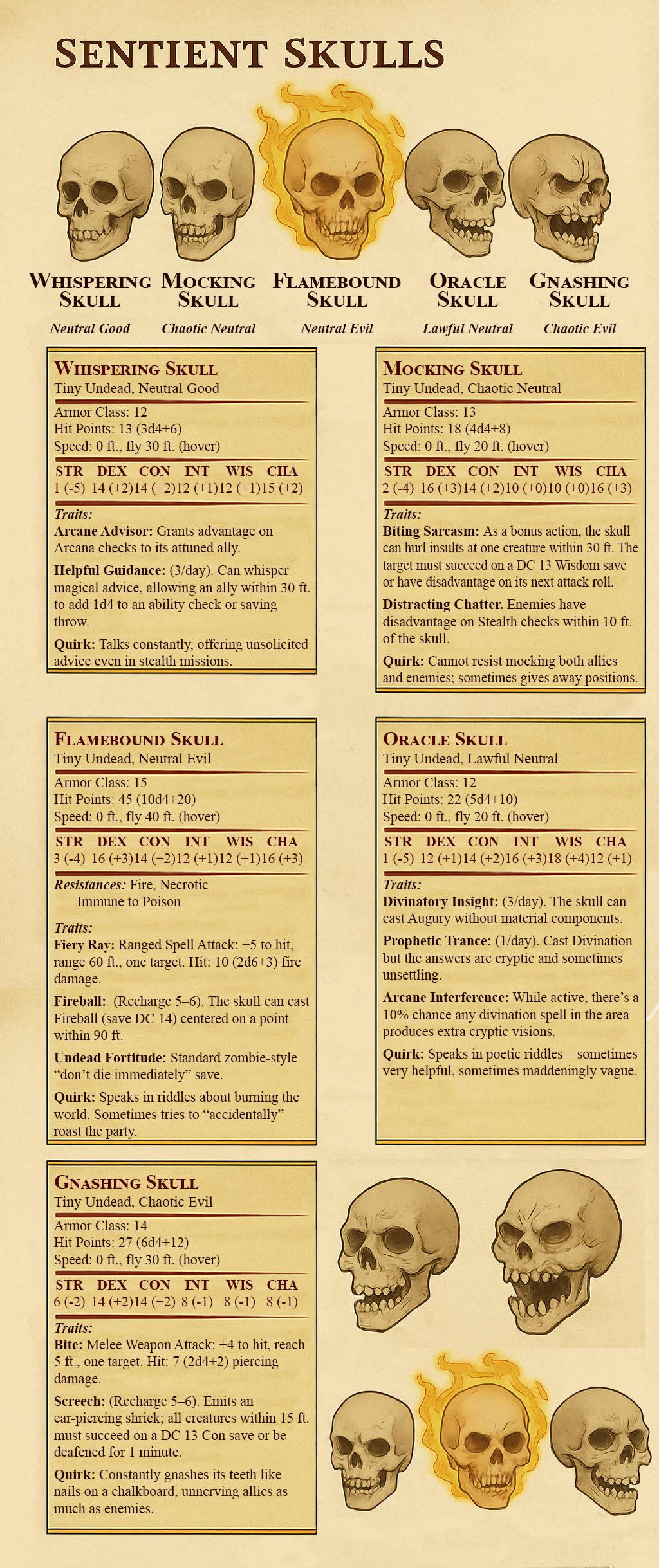
These five are currently known:
Whispering Skull
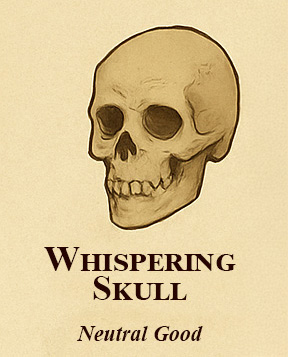
Tiny Undead, Neutral Good
Armor Class: 12
Hit Points: 13 (3d4+6)
Speed: 0 ft., fly 30 ft. (hover)
Abilities:
STR 1 (–5), DEX 14 (+2), CON 14 (+2)
INT 12 (+1), WIS 12 (+1), CHA 15 (+2)
Traits:
- Arcane Advisor. Grants advantage on Arcana checks to its attuned ally.
- Helpful Guidance (3/day). Can whisper magical advice, allowing an ally within 30 ft. to add 1d4 to an ability check or saving throw.
Quirk: Talks constantly, offering unsolicited advice even in stealth missions.
Action: Gnashing Bite Melee Weapon Attack: +4 to hit, reach 5 ft., one target.
Hit: 7 (2d4+2) piercing damage.
Mocking Skull
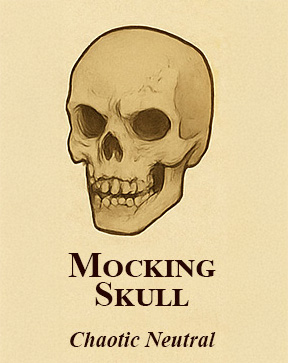
Tiny Undead, Chaotic Neutral
Armor Class: 13
Hit Points: 18 (4d4+8)
Speed: 0 ft., fly 20 ft. (hover)
Abilities:
STR 2 (–4), DEX 16 (+3), CON 14 (+2)
INT 10 (+0), WIS 10 (+0), CHA 16 (+3)
Traits:
- Biting Sarcasm. As a bonus action, the skull can hurl insults at one creature within 30 ft. The target must succeed on a DC 13 Wisdom save or have disadvantage on its next attack roll.
- Distracting Chatter. Enemies have disadvantage on Stealth checks within 10 ft. of the skull.
Quirk: Cannot resist mocking both allies and enemies; sometimes gives away positions.
- Actions:
Maddening Bite Melee Spell Attack: +4 to hit, reach 5 ft., one target. Hit: 6 (1d8+2) psychic damage as the skull’s laughter echoes in the victim’s mind. Target must succeed on a DC 12 Wisdom saving throw or be frightened of the skull until the end of its next turn. - Gnashing Bite Melee Weapon Attack: +4 to hit, reach 5 ft., one target.
Hit: 7 (2d4+2) piercing damage.
Flamebound Skull
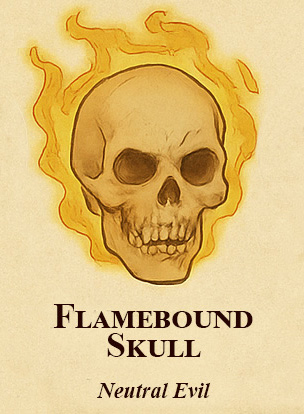
Tiny Undead, Neutral Evil
Armor Class: 15
Hit Points: 45 (10d4+20)
Speed: 0 ft., fly 40 ft. (hover)
Abilities:
STR 3 (–4), DEX 16 (+3), CON 14 (+2)
INT 12 (+1), WIS 12 (+1), CHA 16 (+3)
Resistances: Fire, Necrotic; Immune to Poison
Traits:
- Undead Fortitude. Standard zombie-style “don’t die immediately” save.
Quirk: Speaks in riddles about burning the world. Sometimes tries to “accidentally” roast the party.
Actions:
- Gnashing Bite Melee Weapon Attack: +4 to hit, reach 5 ft., one target.
Hit: 7 (2d4+2) piercing damage. - Burning Bite Melee Weapon Attack: +5 to hit, reach 5 ft., one target.
Hit: 8 (1d6+5) piercing damage plus 7 (2d6) fire damage. On a failed DC 13 Dexterity save, the target catches fire, taking 3 (1d6) fire damage at the start of each of its turns until extinguished. - Fiery Ray. Ranged Spell Attack: +5 to hit, range 60 ft., one target. Hit: 10 (2d6+3) fire damage.
- Fireball (Recharge 5–6). The skull can cast Fireball (save DC 14) centered on a point within 90 ft.
See what happens when you mount a Flamebound Skull on Weirwood Stave
Oracle Skull

Tiny Undead, Lawful Neutral
Armor Class: 12
Hit Points: 22 (5d4+10)
Speed: 0 ft., fly 20 ft. (hover)
Abilities:
STR 1 (–5), DEX 12 (+1), CON 14 (+2)
INT 16 (+3), WIS 18 (+4), CHA 12 (+1)
Traits:
- Divinatory Insight (3/day). The skull can cast Augury without material components.
- Prophetic Trance (1/day). Cast Divination but the answers are cryptic and sometimes unsettling.
- Arcane Interference. While active, there’s a 10% chance any divination spell in the area produces extra cryptic visions.
Quirk: Speaks in poetic riddles—sometimes very helpful, sometimes maddeningly vague.
- Actions:
Gnashing Bite Melee Weapon Attack: +4 to hit, reach 5 ft., one target.
Hit: 7 (2d4+2) piercing damage. - Soulfang Bite Melee Spell Attack: +6 to hit, reach 5 ft., one target.
Hit: 12 (2d8+3) necrotic damage. Target must succeed on a DC 14 Wisdom saving throw or be stunned until the start of its next turn, as its spirit reels from the bite.
Gnashing Skull
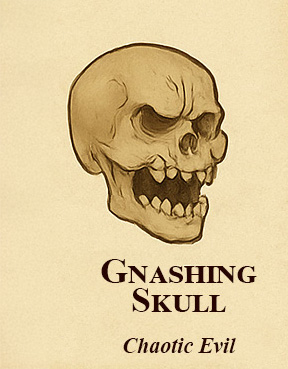
Tiny Undead, Chaotic Evil
Armor Class: 14
Hit Points: 27 (6d4+12)
Speed: 0 ft., fly 30 ft. (hover)
Abilities:
STR 6 (–2), DEX 14 (+2), CON 14 (+2)
INT 8 (–1), WIS 8 (–1), CHA 8 (–1)
Traits: Bites. It bites. It makes no attempt to do anything but bite.
Quirk: Constantly gnashes its teeth like nails on a chalkboard, unnerving allies as much as enemies.
Actions:
- Gnashing Bite Melee Weapon Attack: +4 to hit, reach 5 ft., one target.
Hit: 7 (2d4+2) piercing damage. - Necrotic Bite Melee Weapon Attack: +5 to hit, reach 5 ft., one target.
Hit: 9 (2d6+2) piercing damage plus 5 (1d10) necrotic damage. Target must succeed on a DC 13 Constitution saving throw or have its maximum hit points reduced by the necrotic damage taken until the end of its next long rest. - Screech (Recharge 5–6). Emits an ear-piercing shriek; all creatures within 15 ft. must succeed on a DC 13 Con save or be deafened for 1 minute.
Return to Ye Olde Shoppe of Magicks
Members of DnD Beyond can add the Flamebound, Gnashing, Mocking, Oracle, or Whispering Skulls to their campaigns
Sentient Skulls base images were built using ChatGPT using prompts by Alien Graphics ©2025 Alien Graphics

All verbiage is ©2025 Alien Graphics and all imagery is ©2025 Alien Graphics and shared under the CC BY-NC-SA
 Vulcan Stev's Database