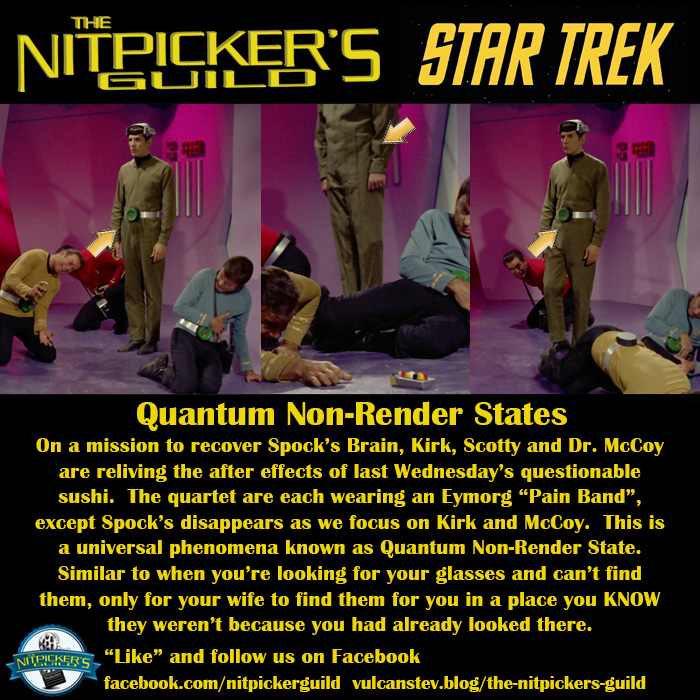
“Spock’s Brain” S3 Ep1
Quantum Non-Render States
The Quantum Non-Render State Hypothesis (QNRSH)
Proposed by the Daystrom Institute of Applied Continuity Physics
Abstract
Matter in the universe, when left unobserved for more than 3.7 seconds, may temporarily de-instantiate from the visible continuum to conserve local narrative energy.
This is known as entering a Quantum Non-Render State (QNRS).
Objects in QNRS remain fully real, but the universe elects not to render them — much like a holodeck pausing background detail to focus processing power on the main character.
Application to Starfleet Incidents
Case Study 1: Spock’s Belt Anomaly, Stardate 5431.4
Spock’s belt, no longer relevant to the ongoing “Brain Incident,” dropped into a QNRS to conserve production resources as we focused on Kirk and McCoy on the floor.
When the surrounding narrative once again focused on Spock’s body, the belt re-rendered at its last logical coordinate.
Case Study 2: Personal Artifact Displacement Syndrome (PADS)
Common among 21st-century humans.
Victims report:
“My glasses were right here a second ago!”
“Where did my keys go?”
“I just had that PADD!”
In 99.8% of cases, the missing item had simply entered a local QNRS. Upon re-rendering, the object reappears in a location optimized for comedic or dramatic effect.
Mechanics
The probability of QNRS activation increases when:
- The object is small, personally important, or urgently needed.
- The observer is late for a meeting or under duress.
- The scene’s emotional pacing requires a minor frustration.
Mathematically expressed as:
P(QNRS) = (U × S) / T²
Where U = urgency, S = stress level, and T = time available before one must leave.
Philosophical Implications
The universe is not chaotic — merely economical.
When your glasses vanish, it’s not forgetfulness; it’s the cosmos managing rendering bandwidth for higher-priority plotlines.
Return to the Nitpicker’s Guild page
Return to the Star Trek page
Return to the Star Trek: TOS page
Return to the Paramount page
 Vulcan Stev's Database