Helgar Goldenvoice – Mythological Lovers separated by some impenetrable abyss, Helgar Longplaits from WarHammer 40K
https://wiki.wizard101central.com/wiki/NPC:Helgar_Goldenvoice
https://en.wikipedia.org/wiki/Orpheus_and_Eurydice
https://en.wikipedia.org/wiki/The_Cowherd_and_the_Weaver_Girl
https://warhammerfantasy.fandom.com/wiki/Helgar_Longplaits
Thank you to Ashley D. for her assistance this one.
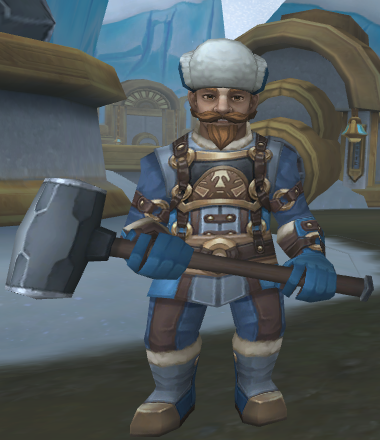
Helgar Goldenvoice, an Ice Dwarf is in love with a Fire Dwarf, Morwen Misteyes. Helgar sends messages through the pipes. He speaks with a voice like polished gold. Alas, since the troubles began, Morwen has heard nothing and begs Your Wizard for assistance. Helgar has been kept from the pipes by Ice Elementals, also the pipes are frozen shut. It’s up to you to reunite these lovers.
Lovers separated by some impenetrable abyss have many inspirations, two of which are most notably similar to Morwen and Helgar; the Greek legend of Orpheus and Eurydice and the Chinese myth of The Cowherd and the Weaver Girl.
In Greek mythology, the legend of Orpheus and Eurydice concerns the pitiful love of Orpheus of Thrace, located in northeastern Greece, for the beautiful Eurydice. Orpheus was the son of Oeagrus and the Muse Calliope. It may be a late addition to the Orpheus myths, as the latter cult-title suggests those attached to Persephone. The subject is among the most frequently retold of all Greek myths.
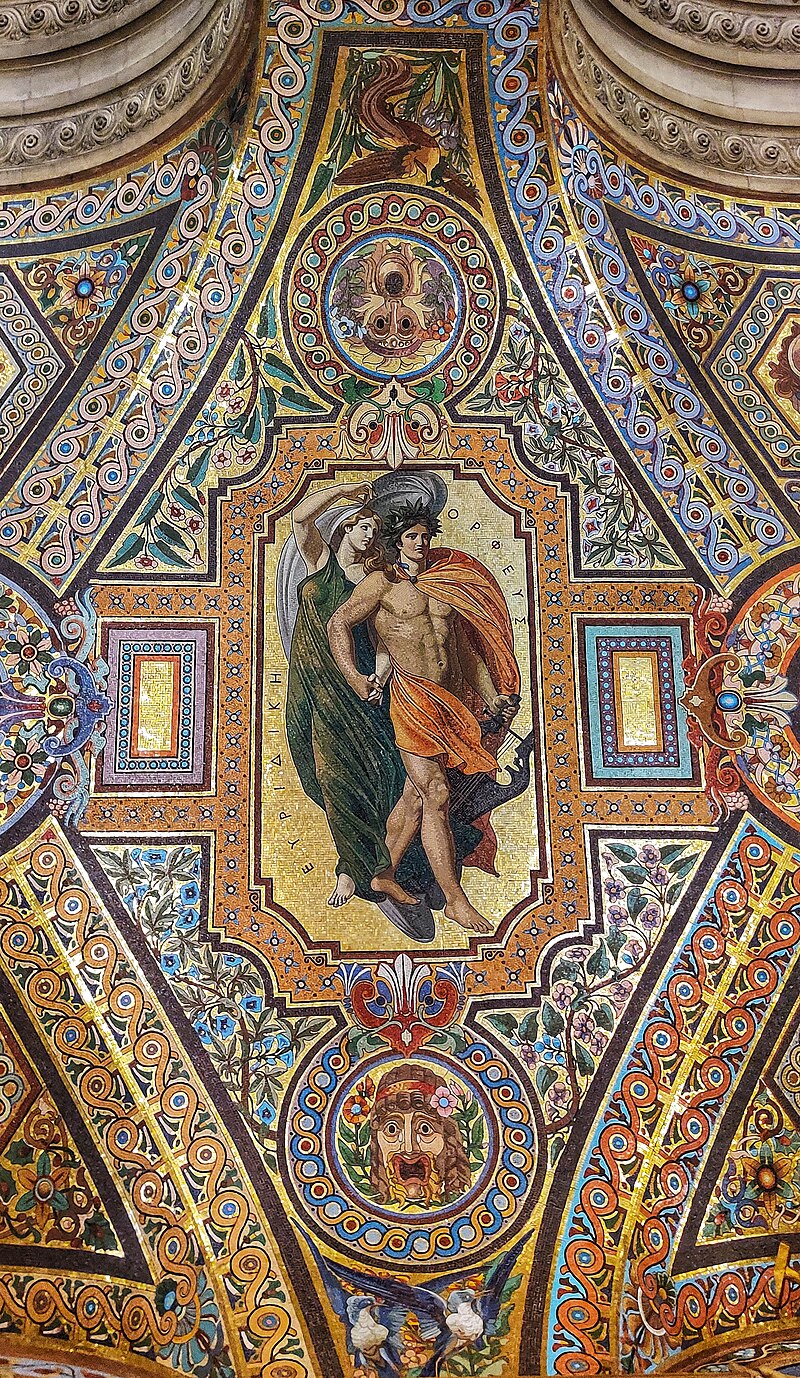
Apollo gave Orpheus a lyre and taught him how to play. It had been said that “nothing could resist Orpheus’s beautiful melodies, neither enemies nor beasts.” Orpheus fell in love with Eurydice, a woman of beauty and grace, whom he married and lived with happily for a short time. However, when Hymen was called to bless the marriage, he predicted that their perfection was not meant to last.
A short time after this prophecy, Eurydice was wandering in the forest with the Nymphs. In some versions of the story, the shepherd Aristaeus saw her and, beguiled by her beauty, made advances towards her and began to chase her. Other versions of the story relate that Eurydice was merely dancing with the Nymphs. Whether fleeing or dancing, she was bitten by a snake and died instantly. Orpheus sang his grief with his lyre and managed to move everything, living or not, in the world; both humans and gods learnt about his sorrow and grief.
At some point, Orpheus decided to descend to Hades by music to see his wife. Any other mortal would have died, but Orpheus, being protected by the gods, went to Hades and arrived at the Stygian realm, passing by ghosts and souls of people unknown. He also managed to attract Cerberus, the three-headed dog, who had a liking for his music. He presented himself in front of the god of the Greek underworld, Hades, and his wife, Persephone.
Orpheus played with his lyre a song so heartbreaking that even Hades himself was moved to compassion. The god told Orpheus that he could take Eurydice back with him, but under two conditions: she would have to walk behind him while walking out from the caves of the underworld, and he could not turn to look at her as they walked.
Thinking it a simple task for a patient man like himself, Orpheus was delighted; he thanked Hades and left to ascend back into the living world. Unable to hear Eurydice’s footsteps, however, he began to fear the gods had fooled him. Eurydice might have been behind him, but as a shade, having to come back into the light to become a full woman again. Only a few feet away from the exit, Orpheus lost his faith and turned to see Eurydice behind him, sending her back to be trapped in Hades’s reign forever.
Orpheus tried to return to the underworld but was unable to, possibly because a person cannot enter the realm of Hades twice while alive. According to various versions of the myth, he played a mourning song with his lyre, calling for death so that he could be united with Eurydice forever. He was killed either by beasts tearing him apart or by the Maenads in a frenzied mood. His head remained fully intact and still sang as it floated in the water before washing up on the island of Lesbos. According to another version, Zeus decided to strike him with lightning, knowing Orpheus might reveal the secrets of the underworld to humans. In this telling, the Muses decided to save his head and keep it among the living people to sing forever, enchanting everyone with his melodies. They additionally cast his lyre into the sky as a constellation.
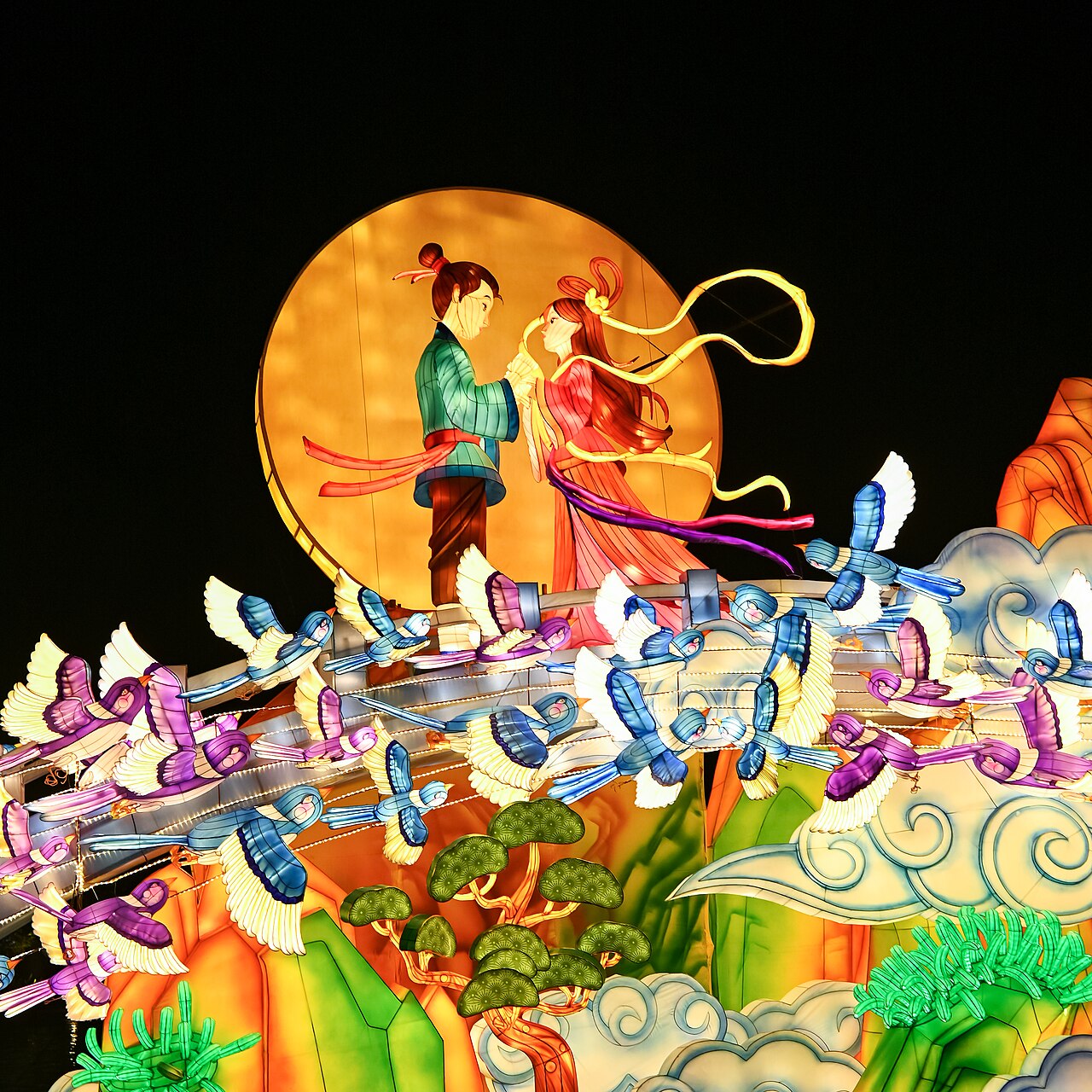
The Cowherd and the Weaver Girl are characters found in Chinese mythology and appear eponymously in a romantic Chinese folk tale. The story tells of the romance between Zhinü (織女; the weaver girl, symbolized by the star Vega) and Niulang (牛郎; the cowherd, symbolized by the star Altair). Despite their love for each other, their romance was forbidden, and thus they were banished to opposite sides of the heavenly river (symbolizing the Milky Way). Once a year, on the seventh day of the seventh lunar month, a flock of magpies would form a bridge to reunite the lovers for a single day.

Translation:
Classic of Poetry, Lesser Court Hymns, Poem 203
…
In Heavens there is the Milky Way,
It looks down and is bright;
slanting is the Weaving Lady,
during one day she is seven times removed.
Although she is seven times removed,
she does not achieve any interwoven pattern;
brilliant is the Draught Ox,
But one does not yoke into any carriage.
The name Helgar (or Helgi, Helga) comes from Old Norse and Old Germanic roots:
heilagr → “holy,” “blessed,” “sacred.”
So Helgar roughly means “the sacred one” or “one blessed by the gods.”
Now, in many mythic traditions, a “sacred” or “blessed” voice is a literal concept — the idea that song or speech is divine.
Think: the “holy singer,” the bard whose music can heal or enchant. Thus, “Helgar” could easily be interpreted as “the blessed voice” — one whose song touches the divine.
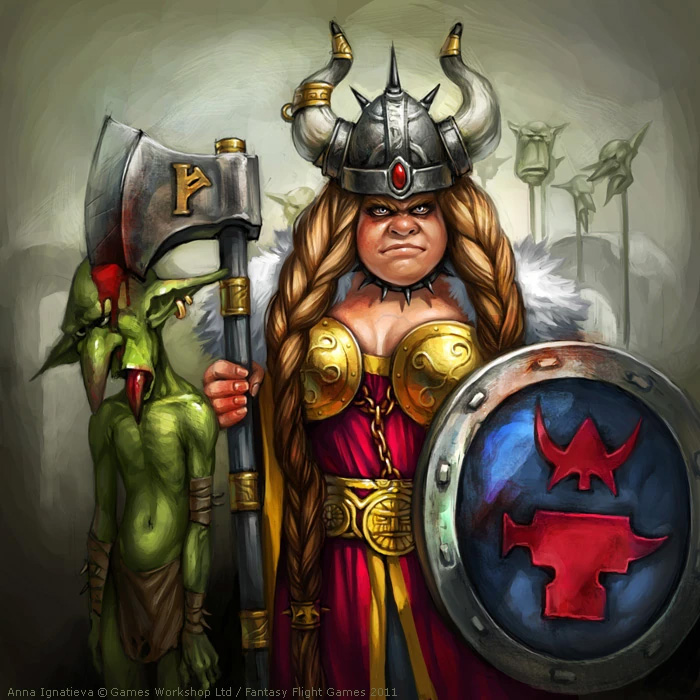
In the WarHammer 40K universe, Helgar Longplaits was the Dwarf Queen of Krag Bryn and a descendant of Bronn the Bold.
As the last living descendant of her ancestor, Helgar was queen when the elves arrived on the nearby shore and began creating a port city they called Tol Eldroth. With a long standing grudge against the nearby hold of Kazad Thrund, all trade inland was heavily taxed but with the Elves she saw a new opportunity. She accepted ambassadors from the city and whilst they had arrived uninvited, she declared she would accept their presence in return for their recognition of her as High Queen of the hold.
Trade began between them and quickly proved successful, even if elven trade goods were called tribute and the dwarf treasure gifted in return would be termed subsidies. She also recieved their pledege to aid her in any battles, as her own forces were now very small.
Angered by the ongoing new trade and still hoping to fulfill his ancestors goal of taking Krag Bryn for himself, Drong the Hard, king of Kazad Thrund sent his kinsman to ferment revolt in her mines, forcing Helgar to seek aid from Lord Eldroth. They dispatched a force under Fendar to intercept the growing band of angry, drunken miners which led to the Battle of Grudge Pass.
The current list of all the (known) Empyrea references can be found here.
Although I am well versed in Pop Culture references but I do not claim to have caught them all. Let me know your favorites in the comments and if I’ve missed one you caught, let me know so I can add it to the list.
Text for this article is excerpted from the linked wiki pages
Helgar Goldenvoice image is from Wizard101, and copyright of KingsIsle Entertainment.
Orpheus and Eurydice image is borrowed from Wikipedia. It is copyright Gre regiment and is shared under the CC BY-SA 4.0 Creative Commons license.
Vega, Altair and the Milky Way image is borrowed from Wikipedia courtesy of NASA. It is in the Public Domain.
The Cowherd and the Weaver Girl image is borrowed from Wikipedia. It is copyright ScribblingGeek and is shared under the CC BY-SA 4.0 Creative Commons license.
Helgar Longplaits image is borrowed from the Warhammer Wiki. Artwork by Anna Ignatieva (c)2011 Games Workshop Ltd / Fantasy Flight games
Image usage qualifies as fair use under US copyright law.
 Vulcan Stev's Database