November’s Blog Carnival Feasts and Festivals is being hosted by of Dice and Dragons
Feasts and Festivals are the way a community bonds together over shared history, religious beliefs, or seasonal celebrations. Even then as the years pass the original reasons for the celebrations can be misremembered, taken out of context or just plain forgotten.
For example the American holiday of Thanksgiving traces back to early harvest celebrations, such as the 1621 event between the Wampanoag people and Pilgrim settlers in Plymouth, Massachusetts. This gathering is famously but inaccurately called the “First Thanksgiving”.
It didn’t became a national holiday until Sarah Josepha Hale finally persuaded Abraham Lincoln to issue a proclamation in 1863. Lincoln’s proclamation aimed to unite the country during the Civil War, and a decade later, Franklin D. Roosevelt moved the holiday to the fourth Thursday of November, which was later codified by Congress.
Today Americans celebrate by serving copious amounts of food, watching football, and arising early the next day to take advantage of Black Friday sales. This is a far cry from the humble beginnings celebrating a successful harvest. But you aren’t going to just drop an American holiday into your game.
A feast or celebration should have traditions that seem ludicrous to an outsider but are taken for granted and accepted as the norm by the locals. There are going to be curmudgeons who do not celebrate. There should be side groups who use the celebration to protest SOMETHING tangentially connected to the original celebration. Without further ado, I hereby present…
Weasel Stomping Day
(Regional Festival of the Midwinter Thaw / “The Taming of the Vermin”)
Overview
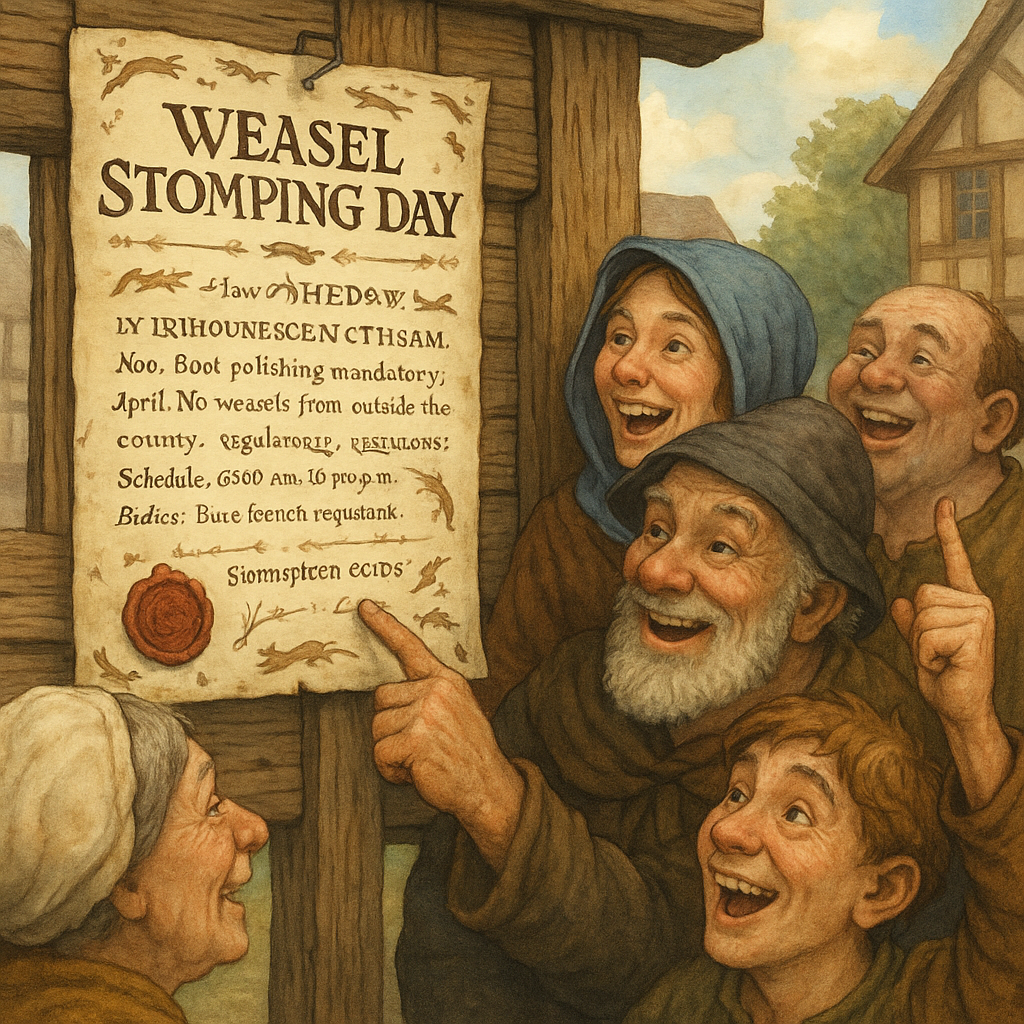
Every year, in the waning weeks of winter, the townsfolk of Grindlemark (or your chosen hamlet) don iron-shod boots, wave banners of crimson and brown, and gather in the village square to celebrate Weasel Stomping Day — a tradition so old that no one quite remembers why it began. What was once a solemn rite of protection against plague and pestilence has, over the centuries, devolved into a gleeful, absurd festival involving effigies, silly songs, and questionable snacks.
Origins (Half-Remembered Folklore)
Long ago, the land suffered from the Great Vermin Plague, when feral weasels infested barns, temples, and even crypts. They were said to carry the Spirit of Hunger, a vengeful winter demon that devoured food stores and livestock.
According to legend, the First Stomping occurred when a desperate priest of the Harvest Goddess strapped iron to his boots and “danced upon the vermin,” banishing the demon with rhythmic stomps and chants. The ritual worked (or seemed to), and the townsfolk declared a yearly re-enactment — both to honor the goddess and to mock the spirit of famine.
Over generations, the original holy rite became warped by folklore:
- The weasels became symbolic (often replaced by sausages or plush toys).
- The chants became drinking songs.
- And the priest became the folk-hero “Old Ironfoot,” a cheery mascot who blesses the fields by stomping them flat.
Modern Celebration Traditions
- The Blessing of the Boots – Participants smear oil and herbs on their boots, claiming it “keeps out weasel spirits.”
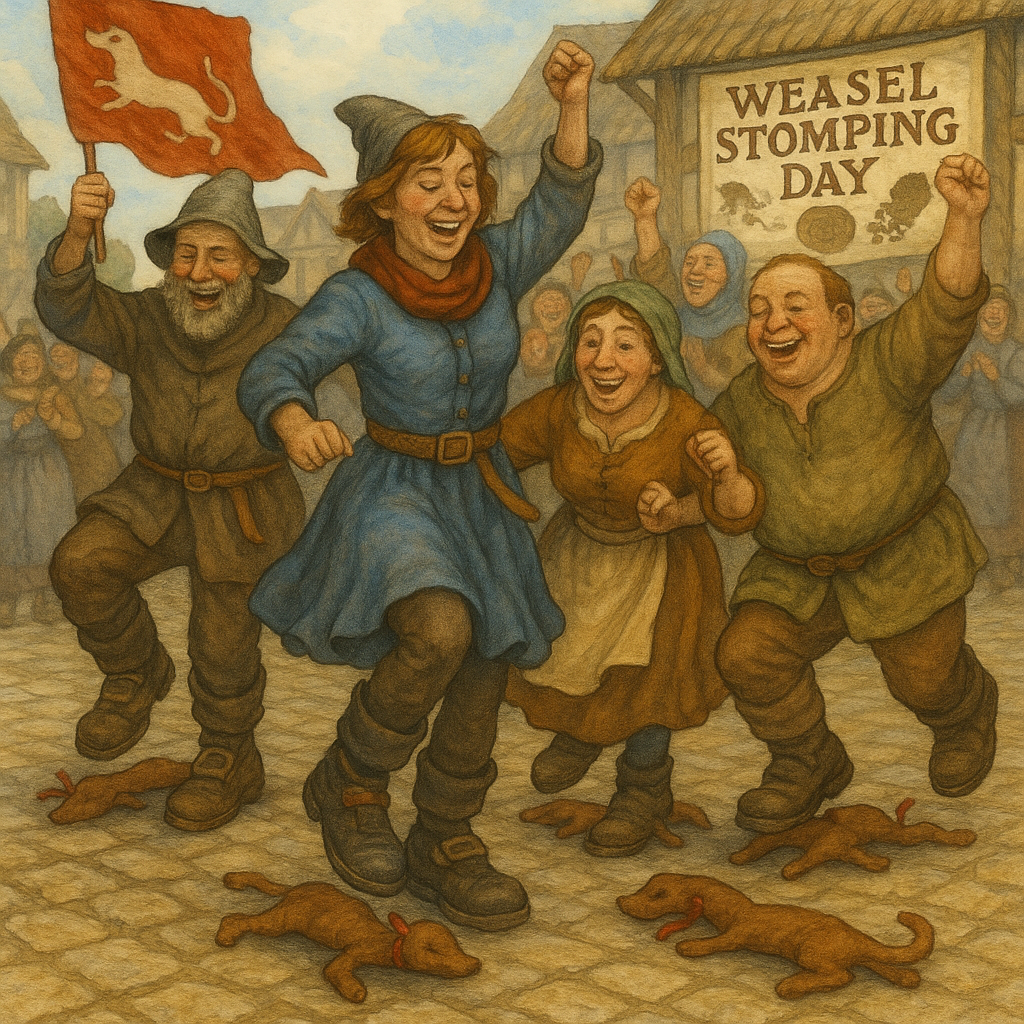
- The Great Stomping Parade – Citizens march through town to lively drumbeats, squishing symbolic “weasels” made of bread, mud, or stuffed sacks.
- Weasel Pudding – A spiced pudding shaped like a ferret, often with raisins for eyes. No actual weasels harmed (usually).
- Effigy Burning – At sunset, an effigy of the Hunger Spirit — half-weasel, half-wraith — is burned in the town square, symbolizing the end of winter’s famine.
- The Dance of Old Ironfoot – A chaotic folk dance where everyone hops in unison while chanting nonsense verses meant to confuse evil spirits (“Stomp three times and wiggle your tail!”).
The Mayonnaise Rite (Modern Addition)
In more recent years, a new “tradition” has taken root among the younger townsfolk — The Spreading of the Mayonnaise.
Description
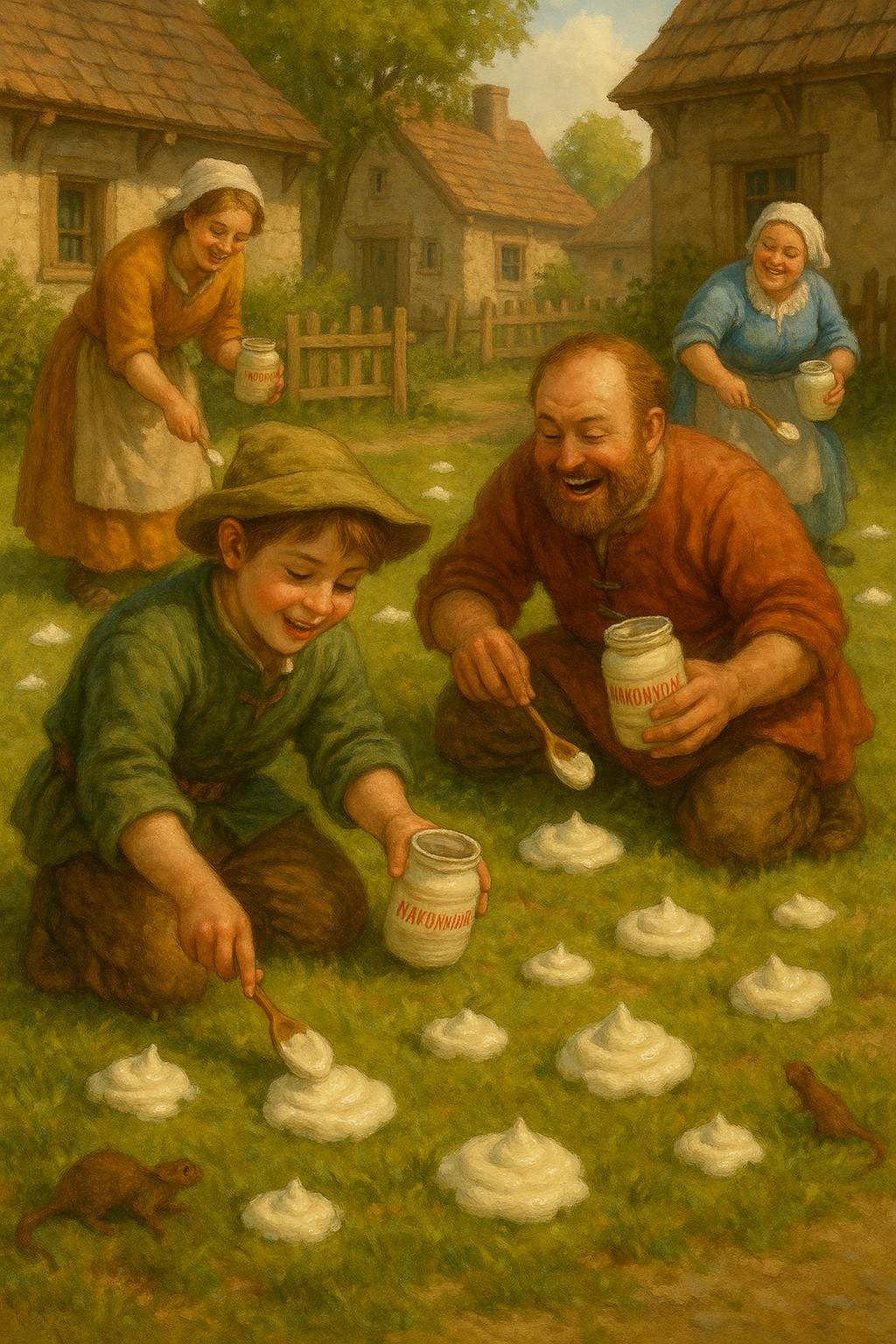
On the morning after the Great Stomping, townsfolk gather in small groups to spread dollops of mayonnaise across the village green and along the fences of their homes, using wooden spoons, bread heels, or occasionally bare hands. The action is performed in cheerful silence (or with drunken giggles), often accompanied by the chant:
“Smooth and white, bring peace tonight!”
Half-Remembered Origins
No one is entirely sure why this is done. Competing theories include:
- The Preservation Theory: The mayo’s oil was once thought to “seal in the spirit of spring” and prevent vermin from returning.
- The Peacemaker’s Feast: Some say it honors the “Weasel King,” an imaginary spirit who accepted tribute in exchange for keeping his kind away.
- The Trader’s Tale: A traveling merchant once arrived mid-festival, selling “Miracle Egg-Paste” as a ward against hunger. The townsfolk bought every jar and smeared it on the lawn — the harvest was good that year, and so the habit stuck.
- The Drunkard’s Explanation: “Someone dropped a sandwich once, and it was funny.” (A surprisingly popular theory. And potentially the most accurate.)
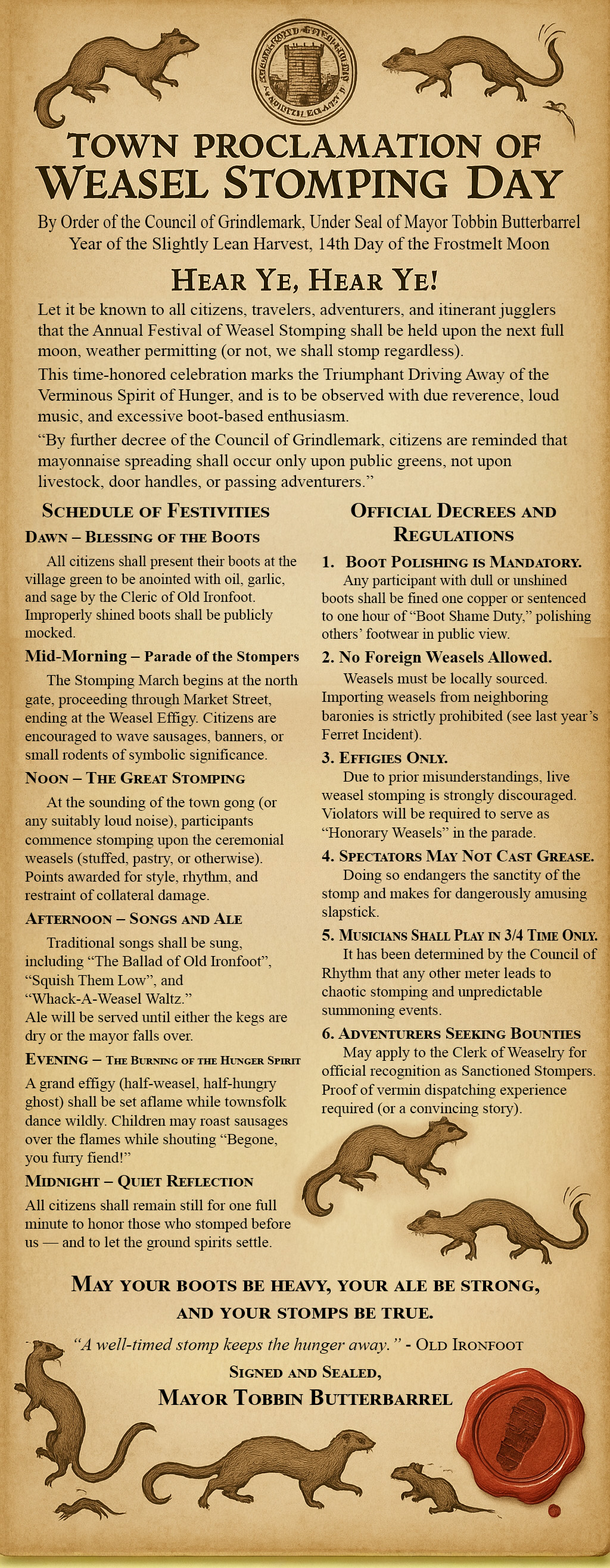
Town Proclamation of Weasel Stomping Day
By Order of the Council of Grindlemark, Under Seal of Mayor Tobbin Butterbarrel
Year of the Slightly Lean Harvest, 14th Day of the Frostmelt Moon
Hear Ye, Hear Ye!
Let it be known to all citizens, travelers, adventurers, and itinerant jugglers that the Annual Festival of Weasel Stomping shall be held upon the next full moon, weather permitting (or not, we shall stomp regardless).
This time-honored celebration marks the Triumphant Driving Away of the Verminous Spirit of Hunger, and is to be observed with due reverence, loud music, and excessive boot-based enthusiasm.
“By further decree of the Council of Grindlemark, citizens are reminded that mayonnaise spreading shall occur only upon public greens, not upon livestock, door handles, or passing adventurers.”
Schedule of Festivities
Dawn – Blessing of the Boots
All citizens shall present their boots at the village green to be anointed with oil, garlic, and sage by the Cleric of Old Ironfoot. Improperly shined boots shall be publicly mocked.
Mid-Morning – Parade of the Stompers
The Stomping March begins at the north gate, proceeding through Market Street, ending at the Weasel Effigy. Citizens are encouraged to wave sausages, banners, or small rodents of symbolic significance.
Noon – The Great Stomping
At the sounding of the town gong (or any suitably loud noise), participants commence stomping upon the ceremonial weasels (stuffed, pastry, or otherwise). Points awarded for style, rhythm, and restraint of collateral damage.
Afternoon – Songs and Ale
Traditional songs shall be sung, including “The Ballad of Old Ironfoot”, “Squish Them Low”, and “Whack-A-Weasel Waltz.”
Ale will be served until either the kegs are dry or the mayor falls over.
Evening – The Burning of the Hunger Spirit
A grand effigy (half-weasel, half-hungry ghost) shall be set aflame while townsfolk dance wildly. Children may roast sausages over the flames while shouting “Begone, you furry fiend!”
Midnight – Quiet Reflection
All citizens shall remain still for one full minute to honor those who stomped before us — and to let the ground spirits settle.
Official Decrees and Regulations
- Boot Polishing is Mandatory.
Any participant with dull or unshined boots shall be fined one copper or sentenced to one hour of “Boot Shame Duty,” polishing others’ footwear in public view. - No Foreign Weasels Allowed.
Weasels must be locally sourced. Importing weasels from neighboring baronies is strictly prohibited (see last year’s Ferret Incident). - Effigies Only.
Due to prior misunderstandings, live weasel stomping is strongly discouraged. Violators will be required to serve as “Honorary Weasels” in the parade. - Spectators May Not Cast Grease.
Doing so endangers the sanctity of the stomp and makes for dangerously amusing slapstick. - Musicians Shall Play in 3/4 Time Only.
It has been determined by the Council of Rhythm that any other meter leads to chaotic stomping and unpredictable summoning events. - Adventurers Seeking Bounties
May apply to the Clerk of Weaselry for official recognition as Sanctioned Stompers. Proof of vermin dispatching experience required (or a convincing story).
In Conclusion
May your boots be heavy, your ale be strong, and your stomps be true.
Remember the old saying of Old Ironfoot:
“A well-timed stomp keeps the hunger away.”
Signed and Sealed,
Mayor Tobbin Butterbarrel
(with flourishes, mud stains, and boot prints of approval)
The Protestors of Weasel Stomping Day
(or “The Society for the Ethical Treatment of Symbolic Vermin”)
The Brotherhood of the Blessed Mustelid
A tiny, overly-serious druidic circle who believe that even symbolic effigies of weasels deserve respect.
- They claim that stomping on effigies “wounds the Weasel Spirit’s feelings.”
- Their counter-holiday, “Hug-a-Weasel Week,” encourages people to knit tiny scarves for local wildlife.
- In one infamous incident, they replaced the town’s stuffed weasel effigies with live ferrets “for authenticity,” which went about as well as you’d imagine.
The Order of Pure Condiments
An ascetic sect of monks who oppose the Mayonnaise Rite on theological grounds, claiming that “eggs, oil, and vinegar are sacred in separation, not in union.”
- They smear mustard on the grass in protest each year.
- Their leader, Brother Clovus, once declared mayonnaise “a heretical emulsion.”
- Their protests have unintentionally created a lucrative condiment rivalry between local merchants.
The Fellowship of Non-Stompers
A peace-loving guild who refuse to lift their feet in anger — even in celebration.
- Their motto: “You can’t stomp out hate by stomping.”
- They perform interpretive dances around the effigies instead.
- The rest of the town finds them annoying but tolerates them because their dances aerate the soil.
The Poultry Preservation Society
They mistakenly believe the festival is about stomping chickens.
- Despite repeated clarification, they continue to hold vigils, release doves, and hand out pamphlets titled “Every Hen Deserves a Friend.”
- Their founder is still convinced the weasel was “a type of duck.”
The Church of Old Ironfoot (Reformist Branch)
A splinter sect of the original faith who insist the festival has lost its solemn meaning.
- They demand a return to the original three-hour dirge and frown upon all dancing.
- Their yearly “Silent Stomp Vigil” attracts no one, but they do get good acoustics under the town bridge.
- The current High Prior, Father Thaddeus Mudtoe, occasionally wanders the parade shouting, “Stop smiling! The famine was real!”
The Historical Accuracy League
A self-important club of amateur historians who argue over which century the first Weasel Stomping occurred.
- They protest not the festival, but the version of the festival currently being celebrated.
- “The effigies should be made of turnip, not straw!” is a recurring slogan.
- No one listens, but the mayor politely invites them to argue among themselves every year to keep them occupied.
NPC Hooks
For roleplay flavor, you might include:
- Merris the Mildly Aggrieved, a scholar who insists the town should celebrate “Stoat Trampling” instead, because “that’s what the ancient records probably meant.”
- Priestess Nell of the Yolk, who hands out flyers about mayonnaise misuse.
- Captain Hobb, who just enjoys breaking up the protests because it adds to the festival chaos.
Possible Hidden “Reasons” or Hooks
- Arcane Residue: The rhythmic stomping actually disrupts ley lines or pestilence spirits. Without the annual ritual, disease might really return.
- Divine Pact: The Harvest Goddess still honors the ritual—though most have forgotten. Those who mock it too loudly risk her mild but comical wrath (spoiled ale, muddy boots, etc.).
- Fey Involvement: A mischievous fey lord once tricked mortals into “dancing the weasels away,” and still watches each year, amused by mortals’ devotion to nonsense.
- Cultural Divide: Neighboring towns see it as barbaric or cruel. Grindlemark insists it’s tradition, sparking comical regional rivalries.
- Dark Twist: The “weasels” were once familiars of a slain witch; each stomp seals her spirit another year longer. The party might discover this, causing a moral dilemma.
Ways to Use It In-Game
- Disguise Opportunity: The chaos of the parade offers perfect cover for intrigue, theft, or assassination attempts.
- Comic Relief Session: Let the players join the festival and try to interpret the nonsensical customs.
- Mini-Game: A “Stomping Contest” with Dexterity checks or performance-based challenges.
- Mystery Plot: The party learns that skipping the celebration has supernatural consequences — famine, monsters, or a literal Weasel Spirit haunting the fields
Yes, I DID crib Weasel Stomping Day from Weird Al. It was too good to pass up and NOT use as the foundation for a completely random holiday.
Return to Nevet’s Archive of RPG Carnival articles
Weasel Stomping Day base images were built using ChatGPT using prompts and modified by Alien Graphics ©2025 Alien Graphics

All verbiage is ©2025 Alien Graphics and all imagery is ©2025 Alien Graphics and shared under the CC BY-NC-SA


This is wonderful, thank you
LikeLiked by 1 person
Thank you for the Kind Words!
LikeLike