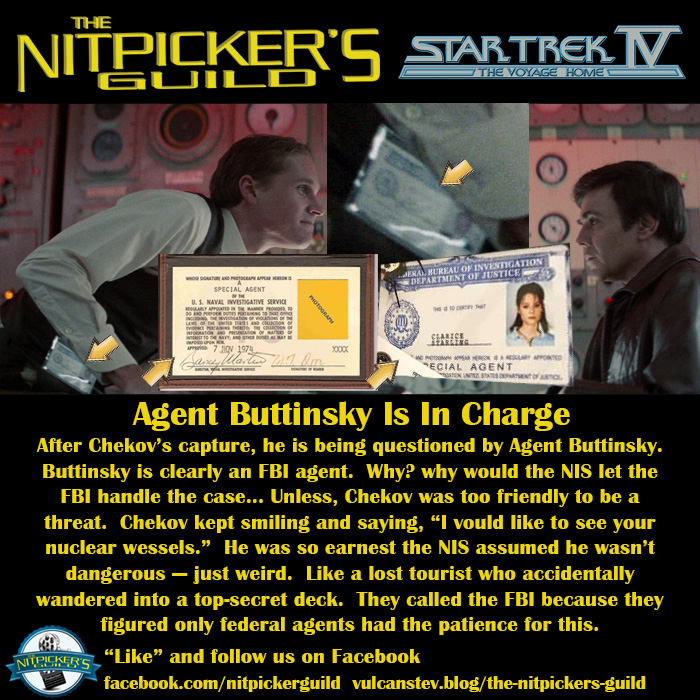
Agent Buttinsky Is In Charge
Yesterday I was speculating who this agent was that questioned Chekov. His credentials didn’t look like either NIS (Naval Investigative Service, the forerunner of NCIS and appropriate agency for the time) nor FBI. However after some investigation, it does appear that Buttinsky is an FBI agent. So WHY would the NCIS turn jurisdiction over to the FBI?
After a FOIA request to the NCIS, the Nitpicker’s Guild was able to uncover this after-action report.
Naval Investigative Service
After-Action Memorandum
Re: Unidentified Foreign National Apprehended Aboard U.S.S. Enterprise
Date: November 12, 1986
From: Lt. Cmdr. Harold E. Wexler, NIS Field Division
To: Director, Naval Investigative Service
Classification: UNCLAS (For Official Use Only)
1. Purpose
This memorandum documents the circumstances under which an unidentified foreign national (later self-identified as “Commander Pavel Chekov”) was detained aboard the U.S.S. Enterprise and subsequently transferred to the custody of the Federal Bureau of Investigation.
2. Summary of Incident
At approximately 1940 hours, ship’s personnel reported a male individual in an unfamiliar naval uniform who had somehow gained access to the Enterprise’s nuclear reactors (“vessels,” pronounced “wessels”). The subject claimed affiliation with the “Star” Fleet while simultaneously displaying characteristics inconsistent with any known program, rank structure, or grooming standard.
3. Rationale for NIS Transfer of Custody
a. Conflicting Agency Jurisdiction
The subject’s accent, while foreign, appeared rehearsed, leading to concerns that the individual might be associated with a classified intelligence program. Due to long-standing interagency precedent, matters involving possible “deep cover” or “double-cover” personnel are traditionally deferred to the FBI to avoid inadvertent interference with ongoing operations.
b. Unclear Classification of Subject’s Equipment
The subject was found in possession of a device resembling an electronic firearm, scanning instrument, or possibly an advanced stapler. NIS personnel were unable to identify, operate, or open it. Per Section 4(b) of the Interagency Equipment Handling Directive, the FBI maintains primary investigative authority for “objects of unknown federal origin.”
c. Ambiguous and Excessively Confident Behavior
The subject displayed unusually high levels of confidence when questioned, to the extent that NIS personnel considered the possibility that he possessed higher clearance than any present investigators. As NIS has previously been reprimanded for detaining individuals later determined to be federal agents, this factor was considered significant.
d. Avoidance of Potential Diplomatic Incident
As subject repeatedly insisted he was “in the fleet,” despite being unfamiliar with standard naval terminology, or chain of command, NIS determined that further questioning risked escalating into a matter requiring State Department intervention. The FBI is better resourced for incidents of this nature.
e. Workload Considerations
NIS manpower was significantly strained due to concurrent investigations involving missing toolkits, unauthorized candy machines in Hangar Two, and an ongoing inquiry into how a seagull gained access to the captain’s ready room.
In light of these operational constraints, the FBI was deemed the appropriate agency to assume custody.
4. Conclusion
Based on the subject’s atypical behavior, unfamiliar equipment, questionable uniform, and the possibility of involvement in classified operations beyond NIS jurisdiction, the decision was made to transfer custody to the FBI without delay.
This action is consistent with interagency policy, risk mitigation strategies, and the longstanding principle of “letting the Bureau handle the weird ones.”
Return to the Nitpicker’s Guild page
Return to the Star Trek page
Return to the Star Trek films page
Return to the Paramount page
 Vulcan Stev's Database