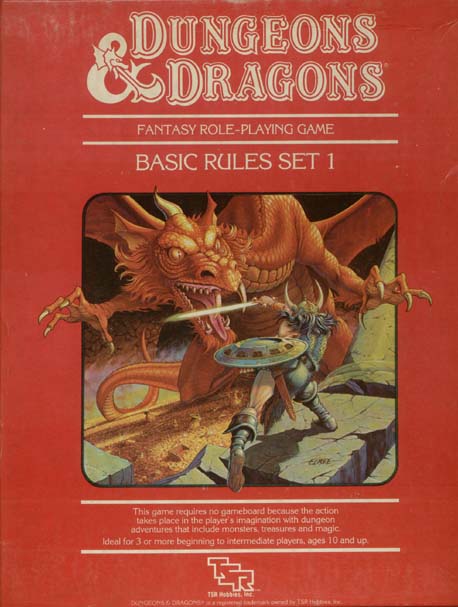
 My recent post asking the question of why do we have D&D edition wars erupting across the blogsphere garnered quite a few responses. The responses were passionate and everyone has their own preferences. I read quite a bit of love and quite a bit of dislike for each edition of D&D.
I want to explore this just a little bit more. What do you like about the editions. What do you not like about the edition in question. Do you have a memory that just stands out and demands to be shared?
Each edition has its good points and its bad points. Too forestall a free form flaming rant, I’m going to section this article off into four parts one for each edition. Let me know what you think without inducing a flame war.
Dungeons & Dragons, the original, affectionately known as the Red Box edition. The grandaddy of all RPGs, this game is most responsible for the state of our hobby today. Would we even be here blogging about our hobby without this game? probably.
What do I like about OD&D?
The combination of Lord of the Rings and Chronicles of Narnia provide a High Fantasy setting for your gaming fun.
What do I not like about OD&D?
Some of the artwork fed right into alarmist crusades against the game. Yes, it seems tame by today’s standards but in the early 80’s some of the states of semi-dressed that the females wear depicted in was positively scandalous.
My main memory about this game was the fact that I began playing RPGs during the height of the “Devil’s Game” scare in the early 80’s. When I did play this version it was in Spanish class, Sra. Machacao let us play as long as we played the entire game in Spanish. To please my parents, I stopped playing D&D and as a result I left the hobby for quite a long time.
 Your turn
 Vulcan Stev's Database
I like that the focus in OD&D is the overall adventure (strategic) rather than combat (tactical). Combat is not uncommon, but it’s not the point of the game, and more of a means to an end — rather than the object of play itself.
Gameplay is faster than other editions, and easier for people to remember all the rules for – making it closer to other tabletop games, and an easier game to introduce to new players.
It’s also similar enough to AD&D that you can borrow elements from that game without having to change your game completely.
LikeLike
Uhmmm… That’s neither the original red box edition nor original D&D. That’s the Mentzer edtition. Preceded by Moldvay, Holmes, & White Box. In the interests of historical accuracy. 🙂
The Mentzer Edition is also the first in the Basic, Expert, Masters, Companion, Immortal series of boxed sets that were collected into the Rules Cyclopedia.
I wish I had never strayed from this edition (or more accurately, the previous Moldvay-Cook sets. Red and blue, sometimes refered to as BX to differentiate them from the later BECMI). I love the Cyclopedia and wish I had never parted with my copy. The last pdf I bought before Wizards shot themselves in the foot was a scan. Sadly, it just ain’t the same.
My earliest memories of the game are from BX, 1e PHB, and 1e MMM. We’re talking about the third grade here, so most of my memories are pretty fuzzy until 2e comes along. But, I recall running a certain borderland keep for my cousin who had memorized the bank vaults. I was too naive to change them on the fly, so he got away with a lot he probably shouldn’t have.
LikeLike
I also agree with all of Stuart’s points. Though I had forgotten most of them over the years. I’ve only recently started to reacquaint myself with BX since 4e and the pdf debacle.
LikeLike
@Dr. Checkmate: Keep an eye on E-Bay. I’d lost my B/X books and bought new versions. I think newer RPGs are generally better organized and presented… but of the older editions I think those books did a pretty good job. They even thought about some things in regards to layout that most modern RPG designers seem to overlook.
Some of the jargon/terms could have been better, especially for new players. The stats on a couple of monsters are a bit wonky… although nothing terrible.
Why they include a sample character sheet in the book… but had it *filled in* is a complete mystery. 😀
LikeLike
B/X is my favorite.
What I like – Just about everything… mechanics, feel, monster roster, the Erol Otus art, I even love race = class. I have a whole list of why it my favorite on my blog: http://ode2bd.blogspot.com/2009/04/bx-is-my-favorite.html
What I don’t like – hmmmm…
LikeLike
I remembe the days of that nice red box set. D&D was my gateway into RPGs and that box was the first set I ever owned. I admit it does hold ALOT of nostalgic value and many a game took place with the first 3 sets. Thee were aspects of the system that did not appeal to me in paticular which is probably why I played more 2e AD&D. But Mystara and OD&D will always have a place in my heart. Think I still have my Rulecyclopedia somewhere. Also, while I’m a fan of 4e, i’ll admit to a bit of old school giddiness when I saw the map key that they printed in the DMG. My basic set covers are long gone save for that one map key inside cover. Still gets plenty of use today.
LikeLike
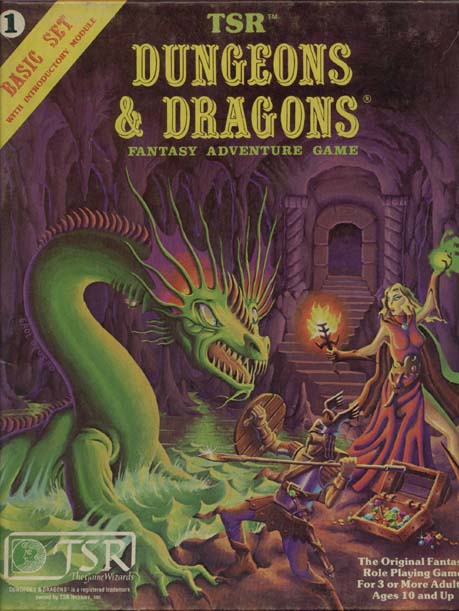
I don’t know if your spam filter will let this fly, but I started out with the 1981 version: http://home.flash.net/~brenfrow/dd/dd-box.htm
We had a lot of fun with the original stuff. Like many others, I wish I still had my Rules Cyclopedia.
LikeLike
Red Box is not OD&D as has been pointed out… That’s limited to the Gygax/Arneson 1974 white box.
http://en.wikipedia.org/wiki/Editions_of_Dungeons_%26_Dragons
LikeLike
Though to follow on, Mentzer was my personal first version of D&D. And it was pretty good! We mainly moved on to AD&D because Basic and Expert were strong but it seemed to get less entertaining and frankly less well-engineered with companion/master/immortal, and also you had to juggle more books the higher level you got, so as we got used to more mid-level stuff we migrated. It definiely had some polish above 1e though…
LikeLike
@everyone. I don’t have a copy of the original edition at all, never did. This is the image I found when I googled Original D&D. I will happily change it if it’ll make everyone happy. 😎
LikeLike
@Stuart – You probably right. We got quite a bit of dungeon crawl during Spanish class.
@Dr. C – Ebay you’d be surprised what you can find if you dig.
@P.Armstrong – Interesting list thanks for sharing. An actual endgame in D&D? who’da thunk?
@geekbob – This post prompted a lot discussion amongst my D&D group. The Rulecyclopedia was brought up quite frequently. I might have to look into that.
@Ruminator – Thank you
@Mxyzplk – I seem to be juggling a lot of books in our current AD&D game.
Looks like D&D pre AD&D has quite a following
LikeLike
Original Edition D&D (plus supplements) – 1974:
http://en.wikipedia.org/wiki/Dungeons_%26_Dragons_(1974)
http://www.acaeum.com/ddindexes/setpages/original.html
Basic Editions:
http://www.acaeum.com/ddindexes/setpages/basic.html
http://en.wikipedia.org/wiki/Dungeons_and_Dragons_Basic_Rule_Set_1
Holmes Basic – 1977 – the first Basic set released, known as “Blue Book”
Moldvay Basic – 1981 – 2nd edition of Basic, introduced Expert rules, commonly known as B/X.
Mentzer Basic – 1983 – 3rd edition of Basic, became BECMI and Rules Cyclopedia.
LikeLike
Actually both of those are “Basic” D&D.
This is original D&D,
There are some differences.
LikeLike
No linking I guess.
Here is Original D&D.
LikeLike
@Chgowiz and Tim – Thanks for continuing my D&D education.
LikeLike
Dislike: Race as class.
Save or die.
Like: Dunno, been to long since I played it. I suppose I like the fact that it introduced me to role playing.
LikeLike
What I don’t like about OD&D:
1) That it spawns its own edition wars, mostly about semantics
2) Inconsistency
3) It fostered a belief in many gamers that the entirety of roleplaying was running tournament modules
What I like about OD&D:
1) The mental buy-in to learn the rules and play was balanced near-perfect
2) The underlying feelings that it’s being built organically during play, and anything is possible in game
What I hate about OD&D:
1) Race as class
2) Racial level limitations
3) Limited mechanics, especially for character creation
4) That so much of it–especially regarding campaign worlds–existed only at the table, &/or only in the minds of a rather small number of DM’s
LikeLike
Just a random comment (long after the string has died), but only because I don’t see it mentioned previously as a reason to like the Red Box edition: the basic rules allowed so much more for imagination as the key driver to the game. I’m 35 years old now, and whenever I wander into a game shop and see what passes for Dungeons & Dragons these days, I get a little depressed by how structured everything is. There were no “real” rules in the old days, beyond the minimal basics. Now it seems there’s a rule for everything. (sigh)
LikeLike
mazmorras y dragones! That’s pretty cool. I never would have tried to play D&D in school, the beatings were already savage enough
LikeLike