Catrin Cheshire – The Cheshire Cat / Irene Adler
https://www.wizard101central.com/wiki/NPC:Catrin_Cheshire
https://en.wikipedia.org/wiki/Cheshire_Cat
https://en.wikipedia.org/wiki/Irene_Adler
https://en.wikipedia.org/wiki/Tannh%C3%A4user_(opera)
https://en.wikipedia.org/wiki/What%27s_Opera,_Doc%3F
https://youtu.be/KZTE9MDoaLs
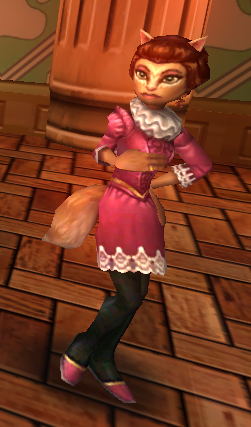
An artist cat hired by Doctor Jackall to find the Queen’s Jewels. Her servants are The Woman’s Right Hand and The Woman’s Fist.
I have to thank my Twitter friend @pipdidart for this one. When originally researching the pop culture connections of Catrin Cheshire I focused on the Sherlock Holmes connection and determined I did not have enough connection aside from Catrin being an opera singer to make the call. @pipdidart pointed out the Alice in Wonderland reference. D’oh forest for the trees. Rereading the quest dialogue I can say that Catrin is inspired by both the Cheshire Cat and Irene Adler. I also found a juicy bit in Sherlock’s dialogue that I’ll share at the end of the article.
The Cheshire Cat is a fictional cat popularized by Lewis Carroll in Alice’s Adventures in Wonderland and known for its distinctive mischievous grin. While now most often used in Alice-related contexts, the association of a “Cheshire cat” with grinning predates the 1865 book. It has transcended the context of literature and become enmeshed in popular culture, appearing in various forms of media, from political cartoons to television, as well as in cross-disciplinary studies, from business to science. One distinguishing feature of the Alice-style Cheshire Cat involves a periodic gradual disappearance of its body, leaving only one last visible trace: its iconic grin. He belongs to the Duchess.

for The Nursery “Alice”
Irene Adler is a fictional character in the Sherlock Holmes stories written by Sir Arthur Conan Doyle. A former opera singer and actress, she was featured in the short story “A Scandal in Bohemia”, published in July 1891. Adler is one of the most notable female characters in the Sherlock Holmes series, despite appearing in only one story. While not technically a criminal and bearing no malice towards Holmes, she outsmarts him and evades his traps. Sherlock Holmes refers to her afterward respectfully as “the Woman.”

in Sherlock Holmes (2009)
In the original Doyle story, Watson notes Holmes has no romantic interest in Adler or in women in general, pointing out the detective only exhibits a platonic admiration for her wit and cunning. Despite this, some derivative works reinterpret Adler as a romantic interest for Holmes or as a former love who later regularly engages in crime. She is portrayed by Rachel McAdams in the 2009 film Sherlock Holmes.
Sherlock’s statement that “Although the Valencians originated the Opera, it was refined and and enhanced at Tannhauser. Kill the Kanichen… Kill the Kanichen…” This references not only a famous opera by Wagner but one of the all-time great Looney Tunes shorts, “What’s Opera Doc?” (1957) [‘kanichen’ is german for rabbit]

Tannhäuser (German full title Tannhäuser und der Sängerkrieg auf Wartburg, “Tannhäuser and the Minnesängers’ Contest at Wartburg”) is an 1845 opera in three acts, with music and text by Richard Wagner (WWV 70 in the catalogue of the composer’s works). It is based on two German legends: Tannhäuser, the mythologized medieval German Minnesänger and poet, and the tale of the Wartburg Song Contest. The story centers on the struggle between sacred and profane love, as well as redemption through love, a theme running through most of Wagner’s work. The opera remains a staple of major opera house repertoire in the 21st century.

What’s Opera, Doc? is a 1957 American Warner Bros. Merrie Melodies cartoon directed by Chuck Jones and written by Michael Maltese. The short was released on July 6, 1957, and stars Bugs Bunny and Elmer Fudd.
The story features Elmer chasing Bugs through a parody of 19th-century classical composer Richard Wagner’s operas, particularly Der Ring des Nibelungen (The Ring of the Nibelung), Der Fliegende Holländer (The Flying Dutchman), and Tannhäuser. It borrows heavily from the second opera in the “Ring Cycle” Die Walküre, woven around the typical Bugs–Elmer feud. The short marks the final appearance of Elmer Fudd in a Chuck Jones cartoon.
It has been widely praised by many in the animation industry as the greatest animated cartoon that Warner Bros. ever released, and has been ranked as such in the top 50 animated cartoons of all time. In 1992, the Library of Congress deemed it “culturally, historically or aesthetically significant”, and selected it for preservation in the National Film Registry, the first cartoon short film to receive such honors.
The current list of all the (known) Marleybone references are located here.
Although I am well versed in Pop Culture references but I do not claim to have caught them all. Let me know your favorites in the comments and if I’ve missed one you caught, let me know so I can add it to the list.
Text for this article is excerpted from the linked wiki pages
Catrin Cheshire image is from Wizard101, and is copyright of KingsIsle Entertainment.
Cheshire Cat image is borrowed from Wikipedia and is in the public domain
Sherlock Holmes (2009) image is (c)2009 Warner Bros.
What’s Opera Doc? image and video is (c)1957 Warner Bros.
Image usage qualifies as fair use under US copyright law.
 Vulcan Stev's Database