Sphinx – Sphinx and the Riddle of the Sphinx
https://wiki.wizard101central.com/wiki/Creature:Sphinx
https://en.wikipedia.org/wiki/Sphinx
https://en.wikipedia.org/wiki/Great_Sphinx_of_Giza
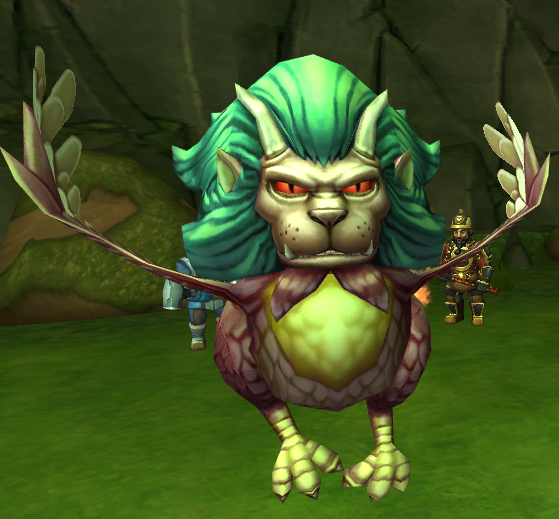
The Sphinx is a monster. A demon, according to Jebediah. It attacks with riddles. It speaks in your mind with hideous brain-teasers. It is now your wizard’s turn to play “Empyrea’s Favorite Game: The Riddle of the Sphinx”
A sphinx is a mythical creature with the head of a human, the body of a lion, and the wings of an eagle.
In Greek tradition, the sphinx is a treacherous and merciless being with the head of a woman, the haunches of a lion, and the wings of a bird. According to Greek myth, she challenges those who encounter her to answer a riddle, and kills and eats them when they fail to solve the riddle. This deadly version of a sphinx appears in the myth and drama of Oedipus.

In Egyptian mythology, in contrast, the sphinx is typically depicted as a man, and is seen as a benevolent representation of strength and ferocity, usually of a pharaoh. Unlike Greek or Levantine/Mesopotamian ones, Egyptian sphinxes were not winged.
Both the Greek and Egyptian sphinxes were thought of as guardians, and statues of them often flank the entrances to temples. During the Renaissance, the sphinx enjoyed a major revival in European decorative art. During this period, images of the sphinx were initially similar to the ancient Egyptian version, but when later exported to other cultures, the sphinx was often conceived of quite differently, partly due to varied translations of descriptions of the originals, and partly through the evolution of the concept as it was integrated into other cultural traditions.
The Sphinx is said to have guarded the entrance to the Greek city of Thebes, asking a riddle to travellers to allow them passage. The exact riddle asked by the Sphinx was not specified by early tellers of the myth, and was not standardized as the one given below until late in Greek history.
It was said in late lore that Hera or Ares sent the Sphinx from her Aethiopian homeland (the Greeks always remembered the foreign origin of the Sphinx) to Thebes in Greece where she asked all passersby the most famous riddle in history: “Which creature has one voice and yet becomes four-footed and two-footed and three-footed?” She strangled and devoured anyone who could not answer. Oedipus solved the riddle by answering: “Man—who crawls on all fours as a baby, then walks on two feet as an adult, and then uses a walking stick in old age”. In some lesser accounts, there was a second riddle: “There are two sisters: one gives birth to the other and she, in turn, gives birth to the first. Who are the two sisters?” The answer is “day and night” (both words—ἡμέρα and νύξ, respectively—are feminine in Ancient Greek). This second riddle is also found in a Gascon version of the myth and could be very ancient. Bested at last, the Sphinx then threw herself from her high rock and died; or, in some versions Oedipus killed her.

The Great Sphinx of Giza is a limestone statue of a reclining sphinx, a mythical creature with the head of a human and the body of a lion. Facing directly from west to east, it stands on the Giza Plateau on the west bank of the Nile in Giza, Egypt. The face of the Sphinx appears to represent the pharaoh Khafre. The original shape of the Sphinx was cut from the bedrock, and has since been restored with layers of limestone blocks. It measures 73 m (240 ft) long from paw to tail, 20 m (66 ft) high from the base to the top of the head and 19 m (62 ft) wide at its rear haunches.
The Sphinx is the oldest known monumental sculpture in Egypt and one of the most recognizable statues in the world. The archaeological evidence suggests that it was created by ancient Egyptians of the Old Kingdom during the reign of Khafre (c. 2558–2532 BC).
The circumstances surrounding the Sphinx’s nose being broken off are uncertain, but close inspection suggests a deliberate act using rods or chisels. Contrary to a popular myth, it was not broken off by cannonfire from Napoleon’s troops during his 1798 Egyptian campaign. Its absence is in fact depicted in artwork predating Napoleon and referred to in descriptions by the 15th-century historian al-Maqrīzī.
The current list of all the (known) Empyrea references can be found here.
Although I am well versed in Pop Culture references but I do not claim to have caught them all. Let me know your favorites in the comments and if I’ve missed one you caught, let me know so I can add it to the list.
Text for this article is excerpted from the linked wiki pages
Sphinx image is from Wizard101, and is copyright of KingsIsle Entertainment.
Attic pyxis Sphinx is borrowed from Wikipedia. It is copyright Marie-Lan Nguyen and is shared under the CC BY 2.5 Creative commons license.
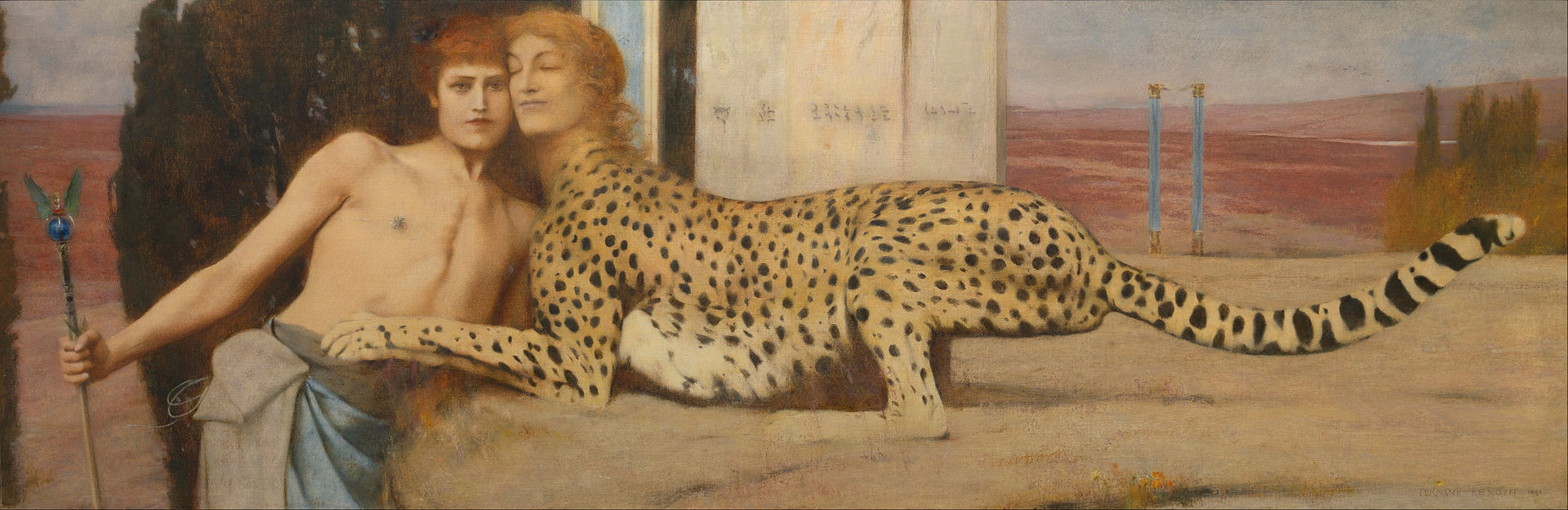
Caresses (1896) by Fernand Khnopff is borrowed from Wikipedia. It is in the public domain.
The Great Sphinx at Giza image is borrowed from Wikipedia. It is copyright MusikAnimal and is shared under the CC BY-SA 3.0 Creative Commons license.
Image usage qualifies as fair use under US copyright law.
 Vulcan Stev's Database