Matilda Collie – Waltzing Matilda
https://wiki.wizard101central.com/wiki/NPC:Matilda_Collie
https://en.wikipedia.org/wiki/Waltzing_Matilda
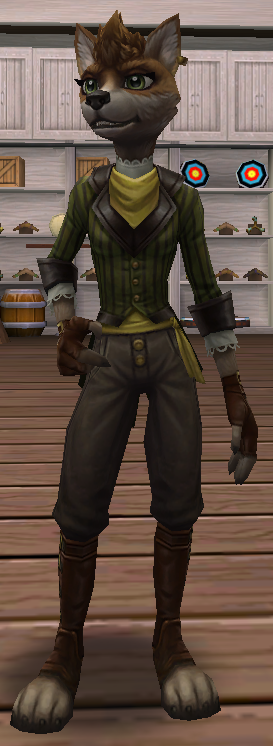
Krokodile Dundara has offered to take your Wizard on a genuine, authentic, unlicensed, Outback expedition. He knows a way out of Hope Springs that Judges aren’t watching. He gives you a list of provisions you’ll need for the trip. After saving Edie from the Dingo bandits ransacking the Outback Stake House, your wizard heads over to Herb’s Food-N-Stuff where Matilda Collie and her associate are “shopping”.
Once you’ve stopped Matilda, she hints there are other parties interested in your Wizard’s visit to Wallaru. AS it turns out she’s in league with Mario di Mario and has hostages sequestered in a cave near the Collie ranch.
“Waltzing Matilda” is a song developed in the Australian style of poetry and folk music called a bush ballad. It has been described as the country’s “unofficial national anthem”.
The title was Australian slang for travelling on foot (waltzing) with one’s belongings in a “matilda” (swag) slung over one’s back, a slang expression that may have originally been repurposed from a work of light verse by Charles Godfrey Leland. The song narrates the story of an itinerant worker, or “swagman”, boiling a billy at a bush camp and capturing a stray jumbuck (sheep) to eat. When the jumbuck’s owner, a squatter (grazier), and three troopers (mounted policemen) pursue the swagman for theft, he declares “You’ll never catch me alive!” and commits suicide by drowning himself in a nearby billabong (watering hole), after which his ghost haunts the site.
The original lyrics were composed in 1895 by Australian poet Banjo Paterson, to a tune played by Christina MacPherson based on her memory of Thomas Bulch’s march Craigielee, which was in turn based on James Barr’s setting for Robert Tannahill’s poem “Thou Bonnie Wood o Craigielee”.

The first published setting of “Waltzing Matilda” was Harry Nathan’s on 20 December 1902. Nathan wrote a new variation of Christina MacPherson’s melody and changed some of the words. Sydney tea merchant, James Inglis, wanted to use “Waltzing Matilda” as an advertising jingle for Billy Tea. In early 1903, Inglis purchased the rights to ‘Waltzing Matilda’ and asked Marie Cowan, the wife of one of his managers, to try her hand at turning it into an advertising jingle. Cowan made some more changes to the words and some very minor changes to Nathan’s melody and gave the song a simple, brisk, harmonious accompaniment which made it very catchy. Her song, published in 1903, grew in popularity, and Cowan’s arrangement remains the best-known version of “Waltzing Matilda”.
Extensive folklore surrounds the song and the process of its creation, to the extent that it has its own museum, the Waltzing Matilda Centre in Winton, in the Queensland outback, where Paterson wrote the lyrics. In 2012, to remind Australians of the song’s significance, Winton organized the inaugural Waltzing Matilda Day to be held on April 6, wrongly thought at the time to be the anniversary of its first performance.

The song was first recorded in 1926 as performed by John Collinson and Russell Callow. In 2008, this recording of “Waltzing Matilda” was added to the Sounds of Australia registry in the National Film and Sound Archive, which says that there are more recordings of “Waltzing Matilda” than any other Australian song.
There are no official lyrics to “Waltzing Matilda” and slight variations can be found in different sources. The following lyrics are the Cowan version published as sheet music in early 1903.
Lyrics to “Waltzing Matilda”
Once a jolly swagman camped by a billabong
Under the shade of a coolibah tree,
And he sang as he watched and waited till his “Billy” boiled,
“You’ll come a-waltzing Matilda, with me.”
Chorus:
Waltzing Matilda, waltzing Matilda,
You’ll come a-waltzing Matilda, with me,
And he sang as he watched and waited till his “Billy” boiled,
“You’ll come a-waltzing Matilda, with me.”
Down came a jumbuck to drink at that billabong,
Up jumped the swagman and grabbed him with glee,
And he sang as he shoved that jumbuck in his tucker bag,
“You’ll come a-waltzing Matilda, with me.”
(Chorus)
Up rode the squatter, mounted on his thoroughbred.
Down came the troopers, one, two, and three.
“Whose is that jumbuck you’ve got in your tucker bag?
You’ll come a-waltzing Matilda, with me.”
(Chorus)
Up jumped the swagman and sprang into the billabong.
“You’ll never catch me alive!” said he
And his ghost may be heard as you pass by that billabong:
“You’ll come a-waltzing Matilda, with me.”
(Chorus)
The lyrics contain many distinctively Australian English words, some now rarely used outside the song. These include:
Glossary:
billabong – an oxbow lake (a cut-off river bend) found alongside a meandering river.
billy – a can for boiling water, usually 1–1.5 litres (2–3 pints).
coolibah tree – a kind of eucalyptus tree which grows near billabongs.
jumbuck – a sheep.
Matilda – a romantic term for a swagman’s bundle. See below, “Waltzing Matilda”.
squatter – Australian squatters started as early farmers who raised livestock on land which they did not have the legal title to use; in many cases they later gained legal use of the land even though they did not have full possession, and became wealthy thanks to these large land holdings. The squatter’s claim to the land may be as unfounded as is the swagman’s claim to the jumbuck.
swagman – a man who travelled the country looking for work. The swagman’s “swag” was a bed roll that bundled his belongings.
troopers – mounted policemen.
tucker bag – a bag for carrying food.
waltzing – derived from the German term auf der Walz, which means to travel while working as a craftsman and learn new techniques from other masters.
Waltzing Matilda – “to waltz Matilda” is to travel with a swag, that is, with all one’s belongings on one’s back wrapped in a blanket or cloth. The exact origins of the term “Matilda” are disputed; one fanciful derivation states that when swagmen met each other at their gatherings, there were rarely women to dance with. Nonetheless, they enjoyed a dance and so danced with their swags, which was given a woman’s name. However, this appears to be influenced by the word “waltz”, hence the introduction of dancing. It seems more likely that, as a swagman’s only companion, the swag came to be personified as a female.
The current list of all the (known) Wallaru references are located here.
Although I am well versed in Pop Culture references but I do not claim to have caught them all. Let me know your favorites in the comments and if I’ve missed one you caught, let me know so I can add it to the list.
Text for this article is excerpted from the linked wiki pages
Matilda Collie image is from Wizard101, and is copyright of KingsIsle Entertainment.
“Waltzing Matilda” sheet music and Swagman images are borrowed from Wikipedia. Both are in the public domain.
Image usage qualifies as fair use under US copyright law.
 Vulcan Stev's Database