Wondrous item, uncommon to very rare
Requires attunement by a Ranger, Druid, Beast Master, or creature proficient in Animal Handling

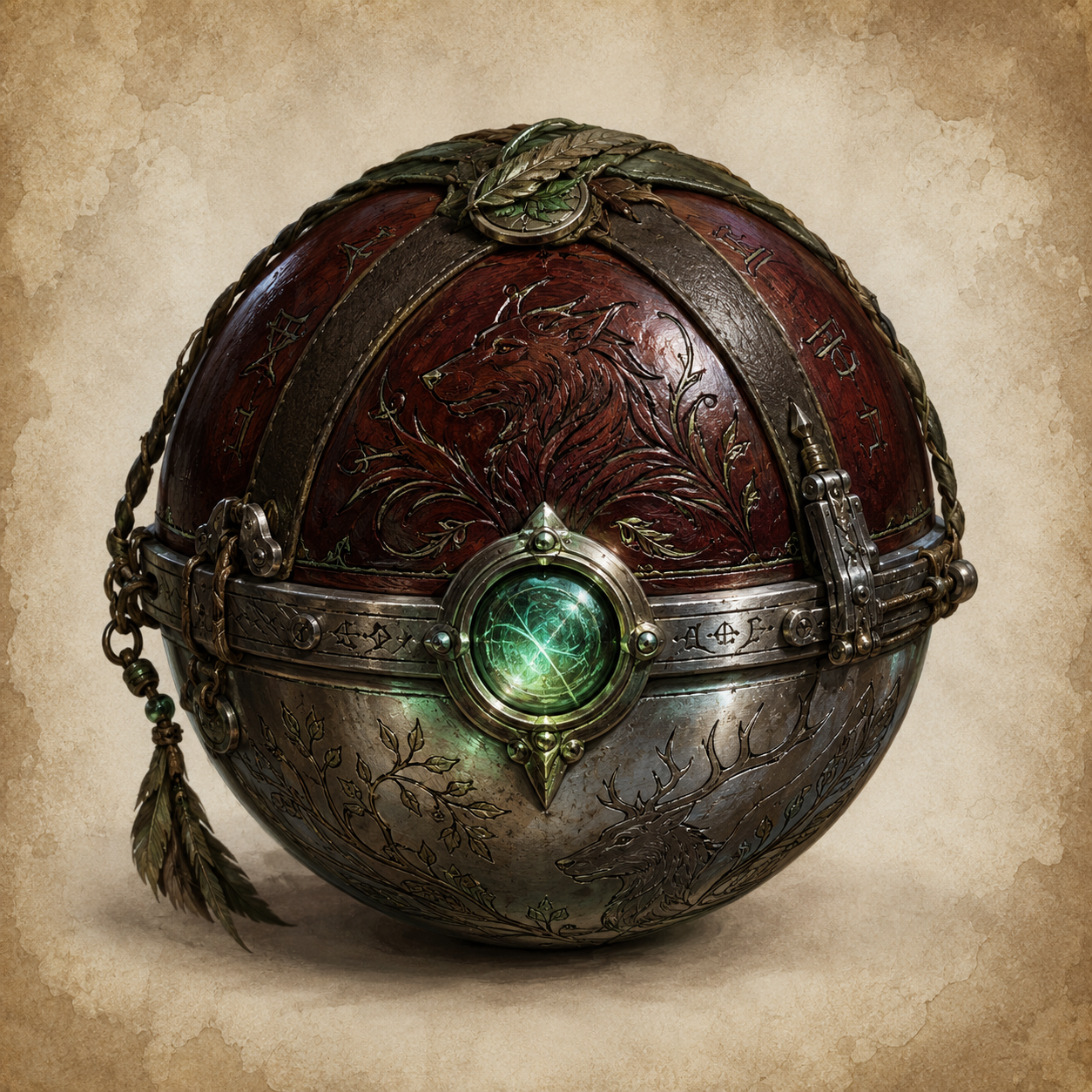
A Ball of Poké is a fist-sized enchanted sphere of lacquered wood, polished steel, and binding crystal. It is designed to temporarily capture, store, transport, and condition beasts for later release. Rangers prize them for relocating dangerous animals, capturing mounts, preserving wounded companions, and — among the morally flexible — building a stable of trained battle beasts.
A Ball of Poké cannot capture humanoids, undead, constructs, fiends, celestials, dragons, giants, or any creature with an Intelligence score of 6 or higher, unless the DM specifically rules otherwise.
Any Ball also refuses creatures that are sentient, uniquely named, magically bound to another master, or protected by divine, planar, or story-important forces.
Ball of Poké Mechanics
Capture Attempt
As an action, you throw the Ball of Poké at a creature you can see within 30 feet.

The target must be:
- A Beast, or another non-sentient creature type approved by the DM
- Medium or smaller (with a standard Ball of Poké)
- At half its hit points or fewer
- Not currently charmed, dominated, summoned, polymorphed, or magically controlled by another creature
- Not already stored in another Ball of Poké (i.e. Ranger A cannot capture Ranger B’s just released beast)
The creature makes a Wisdom saving throw against your Poké Save DC.
Poké Save DC = 8 + your proficiency bonus + your Wisdom modifier
On a failed save, the creature is drawn into the Ball. On a successful save, the Ball snaps open, releases the creature immediately, and the creature becomes immune to capture attempts from that same Ball for 24 hours.
If the target is reduced to one-quarter of its hit points or fewer, it makes the save with disadvantage.
If the target has more than half its hit points, the Ball fails automatically.
Creature Difficulty
Some creatures are harder to catch than others.
| Creature Type | Capture Modifier |
|---|---|
| Ordinary Beast | Normal save |
| Trained Beast | Advantage on save |
| Monstrosity, Plant, or Ooze | Advantage on save |
| Fey Beast or magically altered animal | Advantage on save; +2 bonus |
| Creature with spellcasting, innate magic, or legendary traits | Cannot be captured unless DM allows it |
| Creature with Intelligence 6+ | Cannot be captured unless DM allows it |
| Large or larger creature | Cannot be captured with a Standard Ball of Poké |
A magical creature that fails its saving throw may immediately repeat the save at the end of your next turn. On a success, it bursts free from the Ball, landing in an unoccupied space within 10 feet.
Storage Capacity
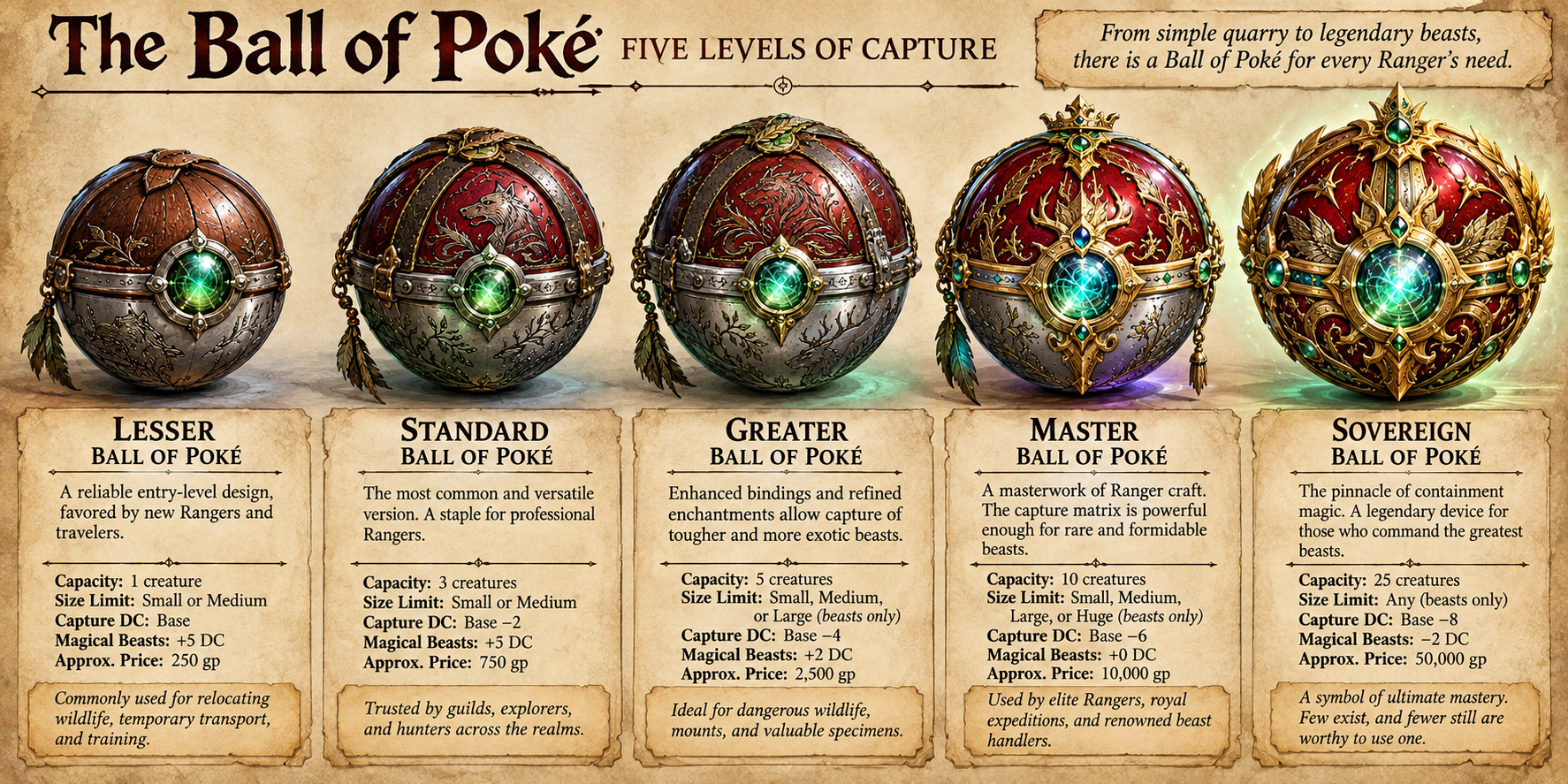
Each Ball of Poké can hold a limited number of creatures. The Ball’s rarity determines its capacity.
| Ball Rarity | Capacity | Maximum Creature Size |
|---|---|---|
| Lesser Ball of Poké | 1 creature | Medium |
| Standard Ball of Poké | 3 creatures | Medium |
| Greater Ball of Poké | 5 creatures | Large |
| Master Ball of Poké | 10 creatures | Huge |
| Sovereign Ball of Poké | 25 creatures | Any non-sentient beast |
A Ball cannot capture a new creature if doing so would exceed its capacity. Creatures inside the Ball are held in a harmless pocket habitat. They do not age, starve, or suffocate, but they will heal naturally while stored.
A creature inside the Ball is aware of the passage of time only dimly, like being half-asleep in a dream.
Releasing a Creature
As an action, you may open the Ball and release one stored creature into an unoccupied space within 15 feet.
When released, the creature is not automatically friendly. Its attitude depends on how long it has been stored and how it was treated before capture.
A released creature acts on its own initiative unless it has become sufficiently conditioned.
Conditioning: “The Longer It Stays, the More It Obeys”
A Ball of Poké gradually conditions captured creatures. This is not true friendship. It is magical obedience mixed with dream-training, scent imprinting, and mild enchantment.
Honestly, it’s a little creepy. Very Ranger-with-a-moral-blind-spot energy.
| Time Stored | Creature’s Attitude |
|---|---|
| Less than 1 hour | Hostile or frightened |
| 1–24 hours | Unfriendly; may flee or defend itself |
| 1–7 days | Indifferent; obeys simple non-dangerous commands |
| 1–4 weeks | Friendly; obeys basic combat commands |
| 1 month or more | Loyal; acts as a trained companion |
| 6 months or more | Subservient; obeys even dangerous commands, unless suicidal |
A creature cannot be made to directly kill itself, leap into obvious death, or violate its most basic instincts unless the DM allows it.
For example, a conditioned wolf might attack an ogre. It will not calmly walk into lava because you said “fetch.”

Commanding a Released Creature
Once a creature has been stored for at least one week, you can command it.
As a bonus action, you may command one released creature from your Ball of Poké to take one of the following actions:
- Attack
- Dash
- Disengage
- Dodge
- Help
- Hide
- Search
If you give no command, the creature defends itself and avoids danger.
You may only command one Poké-bound creature at a time, even if multiple are released.
This prevents the Ranger from becoming a one-person petting zoo artillery battery. We are building a magic item, not launching The Lion King: Tactical Edition.
Bond Strain
The Ball’s magic is not perfect. Keeping too many creatures conditioned puts strain on the wielder.
You may have a number of actively conditioned Poké-bound creatures equal to your proficiency bonus.
If you exceed this limit, each creature beyond that number becomes restless. Whenever you release a restless creature, roll a d6.
| d6 | Result |
|---|---|
| 1 | It immediately flees. |
| 2 | It refuses commands for 1 minute. |
| 3 | It attacks the nearest creature once, then becomes frightened. |
| 4–6 | It obeys normally. For now. |
Escaping the Ball
A creature stored in the Ball may attempt to break free if it is especially strong-willed, magical, or mistreated.
At dawn each day, the following creatures may repeat their Wisdom saving throw:
- A creature captured within the last 24 hours
- A magical creature
- A creature with Intelligence 5
- A creature that was abused, starved, tortured, or repeatedly thrown into lethal danger
- A creature whose natural instincts are being heavily violated
On a success, the Ball cracks open and releases the creature into the nearest unoccupied space. The creature is hostile unless the DM decides otherwise.
Damaging the Ball
A Ball of Poké has:
AC 17
Hit Points 20
Damage Immunities: poison, psychic
Damage Resistances: bludgeoning, piercing, and slashing from nonmagical attacks
If the Ball is reduced to 0 hit points, it breaks. All creatures stored inside are released into the nearest available spaces. Each released creature must make a DC 13 Constitution saving throw, taking 2d6 force damage on a failure, or half as much on a success.
A broken Ball cannot be repaired except by magic such as mending cast daily for 7 days, fabricate, or appropriate artisan work costing half the Ball’s value.
Ranger Feature Interaction
A Beast Master Ranger may treat one creature stored for at least one month as a possible replacement companion, with DM approval.
The creature must still be a valid Ranger companion: no magical monstrosity nonsense unless the DM wants chaos.
A Ranger with Favored Enemy or Deft Explorer may gain advantage on the first capture attempt against a Beast they have tracked for at least 1 hour.
A Ranger may also spend 10 minutes calming a creature before attempting capture. If the Ranger succeeds on a Wisdom (Animal Handling) check contested by the creature’s Wisdom save, the capture attempt does not have advantage or disadvantage, even if the creature is trained.
Suggested Prices
| Type | Rarity | Price |
|---|---|---|
| Lesser Ball of Poké | Common | 250 gp |
| Standard Ball of Poké | Uncommon | 750 gp |
| Greater Ball of Poké | Rare | 2,500 gp |
| Master Ball of Poké | Very Rare | 10,000 gp |
| Sovereign Ball of Poké | Legendary | Priceless / plot item (minimum 50,000 gp) |
Ranger’s Quarry Capture Rule
A Ranger may attempt to capture certain weaker beasts even if they are not reduced to half hit points.
A creature qualifies as Ranger’s Quarry if all of the following are true:
- It is a valid target for the Ball of Poké.
- It can be held by the Ball of Poké.
- It is not sentient, usually Intelligence 5 or lower.
- Its current hit points are equal to or less than 5 × the Ranger’s level.
- The Ranger can see it within the Ball’s normal throwing range.
If these conditions are met, the Ranger may attempt to capture the creature even if the creature has more than half its normal hit points remaining.
Example
A 6th-level Ranger can use this rule against a valid beast with 30 current hit points or fewer.
So a wolf, panther, giant badger, giant poisonous snake, or wounded dire wolf might be fair game. A healthy elephant, giant elk, or angry owlbear is still very much in the “please reconsider your life choices” category.
Capture Save Modifier
If the creature qualifies only because of the Ranger’s Quarry rule and is above half its hit point maximum, it makes its Wisdom saving throw with advantage.
If the creature is both below half hit points and within the Ranger’s Quarry threshold, it makes the save normally.
If the creature is at one-quarter hit points or fewer, it still makes the save with disadvantage.
Optional: Favored Terrain / Favored Enemy Boost
A Ranger has advantage on the throw or imposes disadvantage on the creature’s first capture save if the target is a Beast the Ranger has tracked for at least 10 minutes in one of the Ranger’s favored terrains.
Once per short rest, after observing or tracking a Beast for at least 10 minutes, the Ranger may add their proficiency bonus again to the Ball of Poké’s save DC for that one capture attempt.
Clean Rules Text Version
Ranger’s Quarry. A Ranger attuned to a Ball of Poké may attempt to capture a valid Beast even if it has not been reduced to half its hit points, provided the creature’s current hit points are equal to or less than five times the Ranger’s level. If the creature is above half its hit point maximum when this capture is attempted, it makes its saving throw with advantage. This feature does not bypass the Ball’s other restrictions; the creature must still be Medium or smaller, non-sentient, and an eligible creature type.

Optional Variants
Hunter’s Ball of Poké
Designed for dangerous predators.
Beasts captured by this Ball have disadvantage on their first escape save. However, if they ever break free, they are automatically hostile to the wielder.
Gentle Ball of Poké
This version conditions creatures more slowly, but more ethically.
Double the time required for each attitude improvement, but creatures captured by a Gentle Ball do not make daily escape saves unless mistreated.
Druids prefer these. Rangers pretend not to care but secretly sleep better.
Fey-Touched Ball of Poké
This Ball can capture certain non-sentient Fey beasts or magical animals, but every capture attempt has a complication.
After successfully capturing a magical creature, roll a d6.
| d6 | Complication |
|---|---|
| 1 | The Ball teleports 30 feet in a random direction. |
| 2 | The wielder hears the creature’s dreams for 24 hours. |
| 3 | The creature ages backward by 1d4 days. |
| 4 | The Ball smells strongly of berries and wet dog. |
| 5 | The creature learns the wielder’s name. |
| 6 | No complication. Somehow suspicious. |
DM Notes
The Ball of Poké works best when treated as a Ranger tool, not a summoner exploit. Its limits should be firm:
- No intelligent creatures
- No humanoids
- No Large beasts in a stadard ball
- No dragons
- No legendary monsters
- No “I capture the villain’s owlbear bodyguard in round one” nonsense unless the owlbear is already badly weakened
The best use cases are capturing wolves, panthers, giant frogs, giant owls, riding dogs, blink-dog-adjacent weirdness if allowed, or campaign-specific creatures like Lurklets before they get swamp-murderized.
All imagery had its basic form begin as AI generated art (ChatGPT, Adobe Firefly, etc.) using prompts by Alien Graphics. Modifications handled in Photoshop. ©2026 Alien Graphics

